
Leeham News and Analysis
There's more to real news than a news release.



HOTR: Supply chain hurts A220 assembly flow, big push to meet year-end delivery target
By the Leeham News Team
Dec. 20, 2022, © Leeham News: Airbus’ woes with the A320 family production line are widely reported. So are Boeing’s woes with the 737 line.
 Less well reported are the woes Airbus has with the A220 production lines in Montreal and Mobile (AL).
LNA was informed two weeks ago that the A220 line is its own serious production challenges traced to the supply chain. Rumors circulated that Airbus may shut down the lines to allow the suppliers to catch up.
Airbus’s Montreal office acknowledged challenges but denied the final assembly lines were going to be or were considered for shut down temporarily.
“In order to protect our operations in a complex environment, some ad hoc short-term planning adjustments have been made to align with our supply chain in order to protect our deliveries to our committed customers. We continue to focus on the aircraft that are almost ready for delivery in 2022 and there is no shutdown either of FALs nor pre-FALs planned,” a spokesperson emailed LNA.
Suppliers expect Boeing to increase 787 rates next year
Subscription Required
By Bryan Corliss
Dec. 19, 2023, © Leeham News: Boeing suppliers are planning to increase their output to support the OEM’s plan to deliver five new-built 787s a month at some point in 2023.

Boeing wants to increase the production rate of the 787 to 5/mo by the end of 2023 and to 10/mo by 2025. The supply chain must hurry to prepare. Credit: Leeham News.
It will be challenging for the top-tier suppliers to scale up operations dramatically. They’ll have to train and maintain larger teams of workers, while also ensuring that their own lower-tier suppliers have the capacity to deliver parts and components on time.
One executive warned investors this fall that the challenges in the year ahead will be greater than the ones the industry faced delivering record numbers of planes before the pandemic.
Summary:
- Howmet: ‘Back of the year, at around 5 per month’
- Suppliers want more lead time given challenges
- Whole supply chain is under stress
Leeham News in addition to Twitter, Facebook and Linkedin, may now be found on Post.news here and on Mastodon here.
Pontifications: Nope, not convinced about Boom’s new entrant engine plans
Dec. 19, 2022, © Leeham News: Nope. Not convinced.

By Scott Hamilton
Boom’s CEO Blake Scholl last week announced that he’s put together a group of three companies to work with his firm to design an engine for his Overture supersonic transport.
None of the companies—including Boom—has designed a big jet engine, let alone one for a commercial airliner or an SST.
Yet Scholl said Overture’s first flight will slip only a year, from 2026 to 2027, and entry into service is still set for 2029.
No way will this happen.
Related Article
The three companies are Florida Turbine Technologies, which will design the engines; GE Additive, which will consult on ways to fabricate engine parts through additive manufacturing technology; and StandardAero, which will be Boom’s MRO partner and will consult on making the engines easy to maintain.
Florida Turbine is a subsidiary of Kratos Defense & Security Solutions. It has designed small jet engines for drones and cruise missiles. But not for big jets or SSTs.
Leeham News in addition to Twitter, Facebook and Linkedin, may now be found on Post.news here and on Mastodon here.
Bjorn’s Corner: Sustainable Air Transport. Part 50. eVTOL production volumes.

By Bjorn Fehrm
December 16, 2022, ©. Leeham News: Last week, we looked at the production costs of our typical eVTOL. We could see that it was far higher than Joby’s assumption of $1.3m for the S4, about three times higher for units above 500 and even higher for earlier units.
Let’s examine where such cost numbers come from. It’s about production ramp hockey sticks and numbers never seen before. Are these credible?

Figure 1. The Vertical Aerospace VX4 in an early rendering with similar looks to the eVTOL we discuss. Source: Vertical Aerospace.
Universal Hydrogen could be first with Hydrogen Airliner
Subscription required
By Scott Hamilton and Bjorn Fehrm
Dec. 15, 2022, © Leeham News: Universal Hydrogen (UH2) is perhaps weeks away from its first flight of a demonstrator that equips a De Havilland Canada Dash 8-300 with tanks of hydrogen and a fuel cell electric propulsion unit. The project shall prove the feasibility of hydrogen-fueled airliners.
The first flight’s date hasn’t been firmly set, but officials at UH2 told LNA it should be soon. Taxi tests of the aircraft will begin in the coming weeks. The flight will occur at Moses Lake in Central Washington State.
Universal Hydrogen supplies its hydrogen to the aircraft in prefilled barrel-sized tanks, called capsules, to avoid the lengthy and costly investment in storing and filling infrastructure at airports. The proof of concept is with a Dash 8, followed by a complete hydrogen conversion kit for an ATR-72 turboprop airliner.
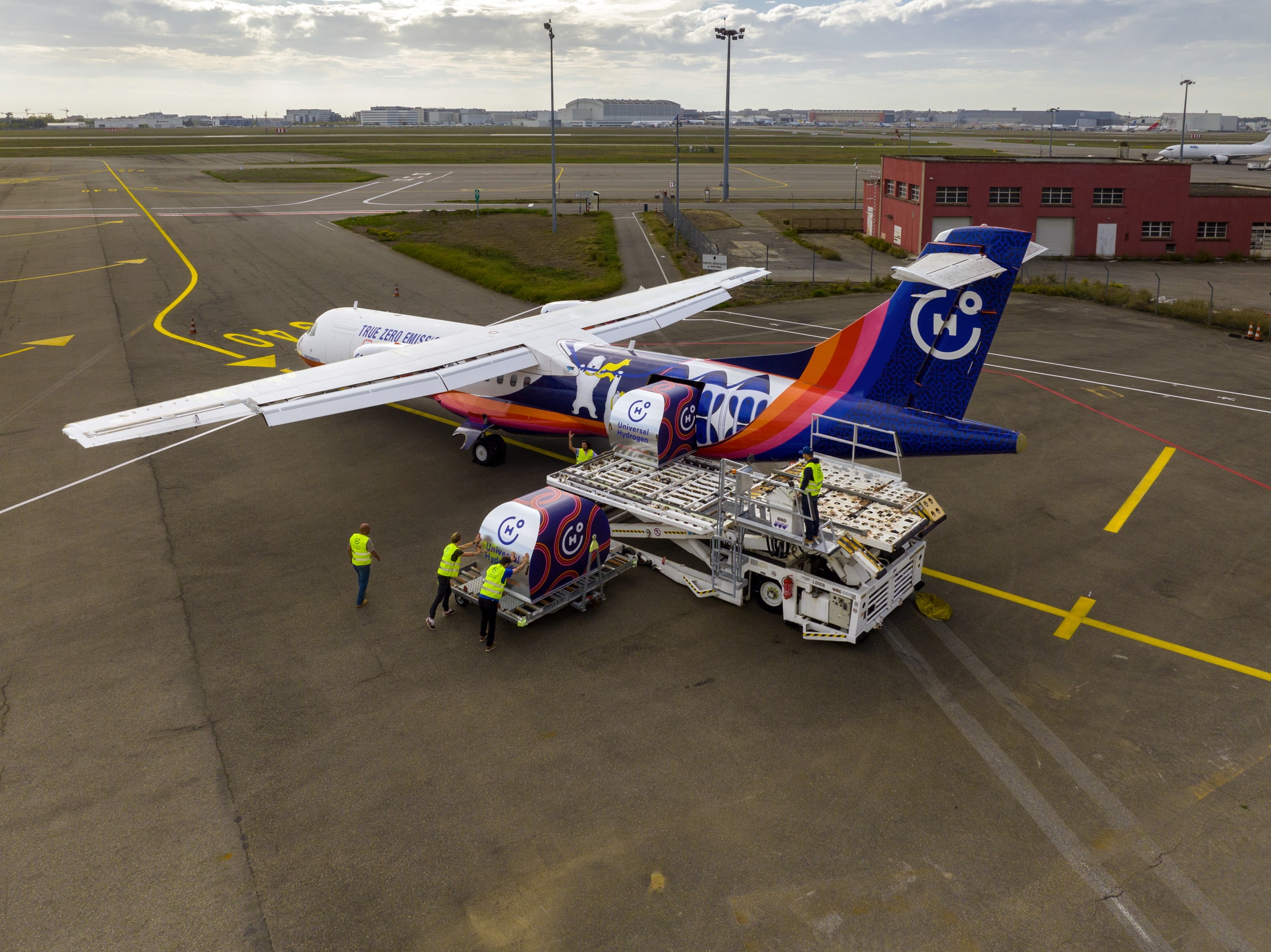
Figure 1. Hydrogen tank pallets are loaded onto an ATR 72 by standard cargo loaders. Source: Universal Hydrogen.
Summary:
- The core business of Universal Hydrogen is the prefilled hydrogen tanks that load onto the aircraft in pallets.
- Universal Hydrogen builds the complete hydrogen fuel and propulsion system to prove and bootstrap the concept of hydrogen airliners.
UPDATE: Boom announces engine partners for proposed supersonic jet
By Bryan Corliss
Dec. 13, © Leeham News: Boom Supersonic announced this morning that it will team with three partners, including a division of GE, to create engines for use specifically on its proposed Overture passenger transport.
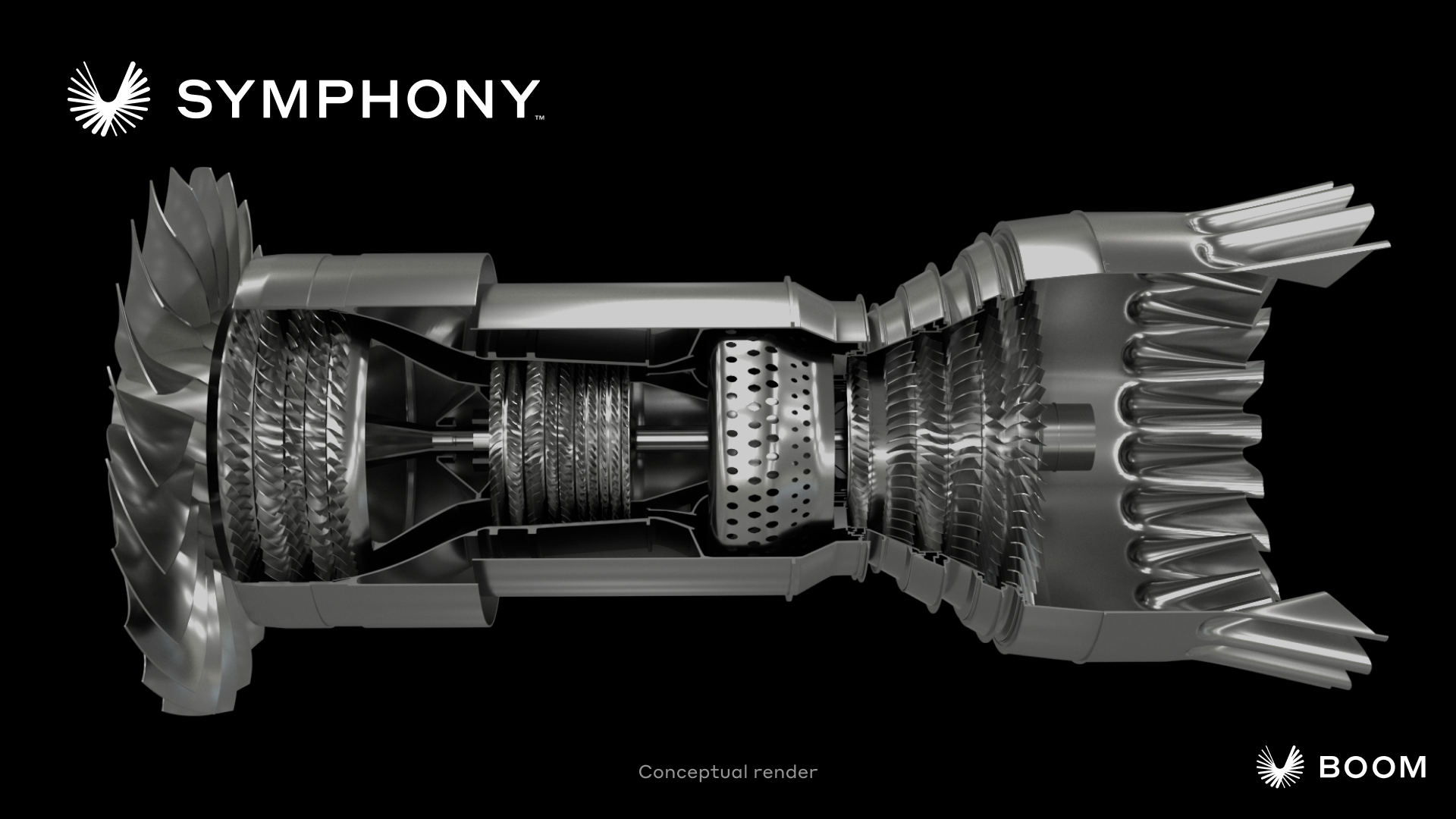 “Developing a supersonic engine specifically for Overture offers by far the best value proposition for our customers,” Boom founder and CEO Blake Scholl said.
The partners are:
- Florida Turbine Technologies, which will design the engines;
- GE Additive, which will consult on ways to fabricate engine parts through additive manufacturing technology; and
- StandardAero, which will be Boom’s MRO partner and will consult on making the engines easy to maintain.
The announcement didn’t specify who will fabricate the engines, or where they will be built. It did note that Standard Aero has experience assembling and servicing supersonic engines for the military. Boom has not yet responded to a request for clarification.
Summary
- Major engine manufacturers had passed on Boom
- Engines could include additively manufactured components
- Significant challenges remain
Read more
United orders 100 Boeing 787s, 100 Boeing 737s, defers Airbus A350 again
 Dec. 13, 2022, © Leeham News: United Airlines today announced a massive order for 100 Boeing 787s and 100 Boeing 737 MAXes. Sub-types weren’t announced. Neither were the engine types for the 787s, which are powered by either GE Aerospace’s GEnx or Rolls-Royce Trent 1000.
An order for 45 Airbus A350s was deferred again, this time to at least 2030. Deliveries were to begin in 2027. The order had been deferred at least twice previously. Reuters reported “United CEO Scott Kirby told reporters ‘the right time for 350 versus (787) conversation is when we’re replacing the bulk of the 777s, which really doesn’t begin to the end of the decade.’” Most observers believe this order will be canceled eventually.
Related articles
At least one more big airline order, Air India, is expected before the end of the year.
How much can China’s traffic growth slow? A look at Japan
Subscription Required
By Vincent Valery
Introduction
Dec. 12, 2022, © Leeham News: The Chinese commercial aviation market is now the second largest in the world after the United States. Growth has been very robust in recent decades, and all major OEMs forecast things to stay this way in the next two decades.

Credit: Japan Rail Pass
However, the Chinese economy’s GDP (Gross Domestic Product) growth rate slowed down significantly throughout the 2010 decade: from around 10% to 6% in 2019. Separately, China’s working-age population peaked during the same decade.
The growth in passenger traffic has historically had a strong correlation with GDP growth. Several studies have shown that passenger traffic has grown 1.5x to 2x faster than GDP. The consequences of a potential passenger traffic growth slowdown in China are, therefore, significant for commercial aircraft OEMs.
Another country in the Asia Pacific region faced a similar situation in the early 1990s: Japan. Even though there are substantial differences between the two countries, analyzing how things played out in Japan could help understand what lies ahead for Chinese passenger traffic growth.
Summary
- Demographic and economic parallels;
- Competition from high-speed rail;
- As Japan’s GDP grew, so did air and train travel;
- Explaining the 2010s Japan air traffic boom;
- Significant differences between China and Japan.
Pontifications: The Queen is Dead. Long live the Queen.
By Scott Hamilton
Dec. 12, 2022, © Leeham News: The 1,574th Boeing 747 rolled off the production line last Tuesday. The last one, after 53 years of continuous production. The iconic aircraft was known as the Queen of the Skies.
The larger A380 didn’t replace the 747. McDonnell Douglas’s DC-10 and MD-11 didn’t replace it. The Lockheed L-1011 didn’t replace it. Neither did Boeing’s own 777-300ER. And neither will the 777X. The 777-X does not replace the 747—it succeeds the 747. I don’t think that anyone will characterize the 777X as “the Queen of the Skies.” The X looks like any other airplane. The 747 look is unique (a well-worn, overused word that in this case applies) and iconic. It has a nose door. The 777XF does not.
The Queen is Dead. Long live the Queen.
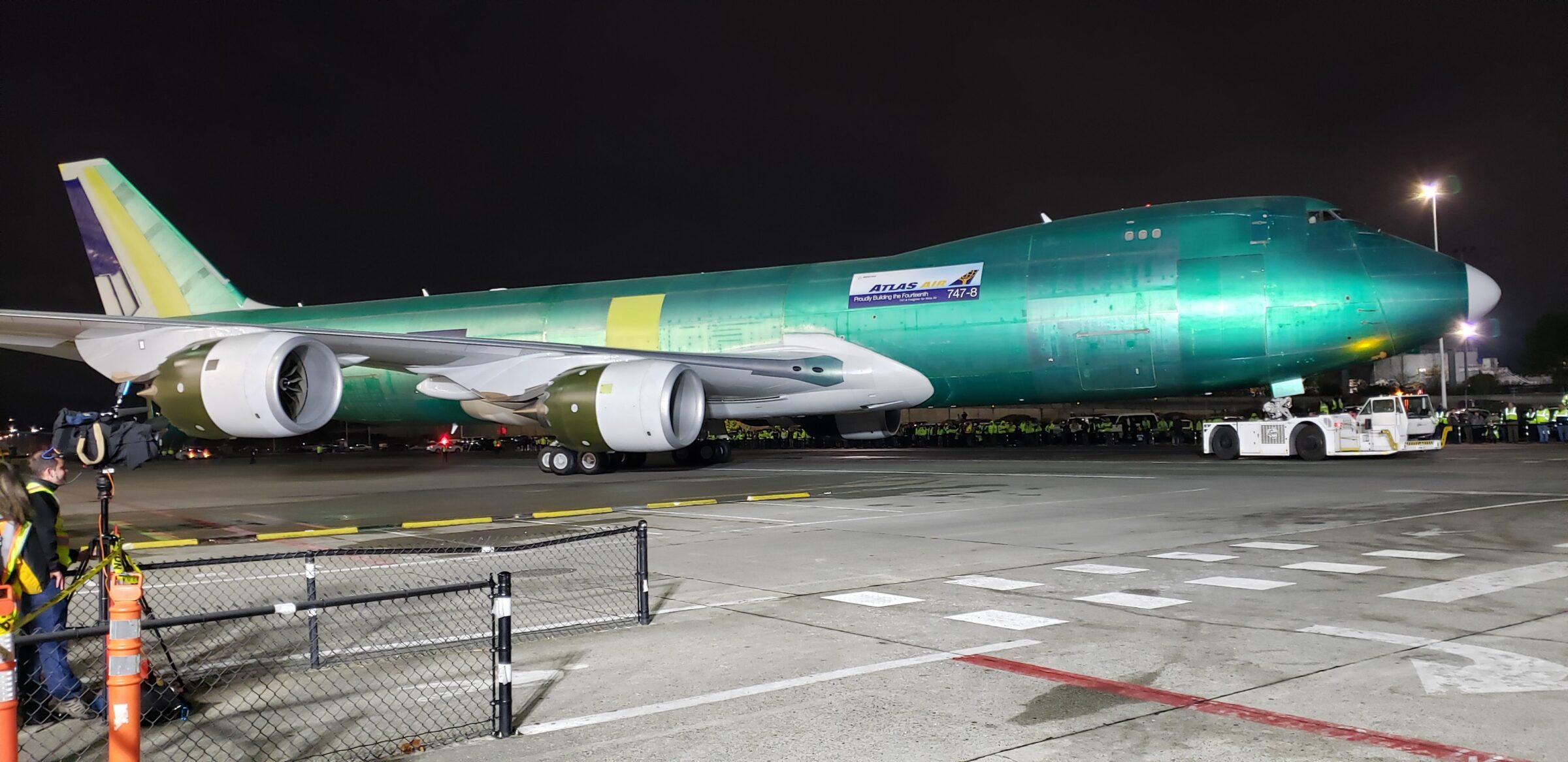
The last Boeing 747 to be built rolled off the Everett factory line Dec. 6, 2022. Line No. 1574 is for Atlas Air. After painting, a decal of legendary engineer Joe Sutter, the father of the 747, will be applied to the starboard side. Photo credit: Leeham News.
As it turns out, there was a debate within Boeing as far back as 2004 about whether to cancel the 747 program then. The 777-300ER was just entering service. There was a recognition within Boeing that the -300ER was the beginning of the end for the 747.
I tell this story in my book, Air Wars, The Global Combat Between Airbus and Boeing. Also in the book is the story about how Boeing tried to launch the 747-500 and 747-600, without success. Airbus won this competition, launching the A380 with Singapore Airlines and in the process killing the 747 derivatives. But Phil Condit, then the CEO of Boeing, wasn’t upset. Something else was in the hopper.
Below is a synopsis of these stories, excerpted from Air Wars.
HOTR: Tuesday’s Boeing announcement may give indication of A350 future at United
By the Leeham News Team
Dec. 9, 2022, © Leeham News: The engine selection on a big Boeing 787 to be announced Tuesday may be the most definitive signal yet of what United Airlines will do with its oft-deferred Airbus A350 order.
United is considered certain at some point to cancel its orders for 45 A350s. This order has been deferred several times. The new order to be announced Tuesday for up to 100 or more Boeing 787s adds to the more than 60 already in the fleet. United clearly doesn’t need a large fleet of 787s and a smaller fleet of A350s.
But canceling the Airbus order is not without some cost. It’s believed that penalties to Airbus are manageable. These also may be mitigated by an order for A321neos. This can solve Airbus’s concerns. But it does nothing for Rolls-Royce, which provides the engines for the A350s.
Rolls is not an engine supplier for the A321neo. United’s swapping the A350 for the A321 means Rolls loses that future business. What’s the mitigation for Rolls?
United may split the engine order for the 787 between incumbent GE Aerospace and Rolls. If the engine selection is announced Tuesday and the order is split, this will be the clearest indication yet that the A350 order will be history. United and Boeing scheduled a press conference at the 787 production and assembly plant in Charleston (SC).