
Leeham News and Analysis
There's more to real news than a news release.


Busy decade ahead for new, derivative airplane EIS dates
The next decade will see an extraordinary number of new and derivative airplanes entering service, beginning next year with the Boeing 787-9 and ending in 2022 with what we believe will be a replacement for the Airbus A330.
Bombardier’s CS100 is currently planned to enter service in around September next year, 12 months after its first flight on September 16, 2013, but we think EIS will slip to early 2015. Bombardier seems to be laying the groundwork for this in statements that it will reassess the EIS date in a few months.
Beginning with the 787-9, there is a steady stream of EIS dates–and a couple of end-production dates of current generation airplanes.
This chart captures the airplanes and their dates. Most dates are based on firm announcements from the OEMs, but we’ve adjusted some based on market intelligence and our own estimates.
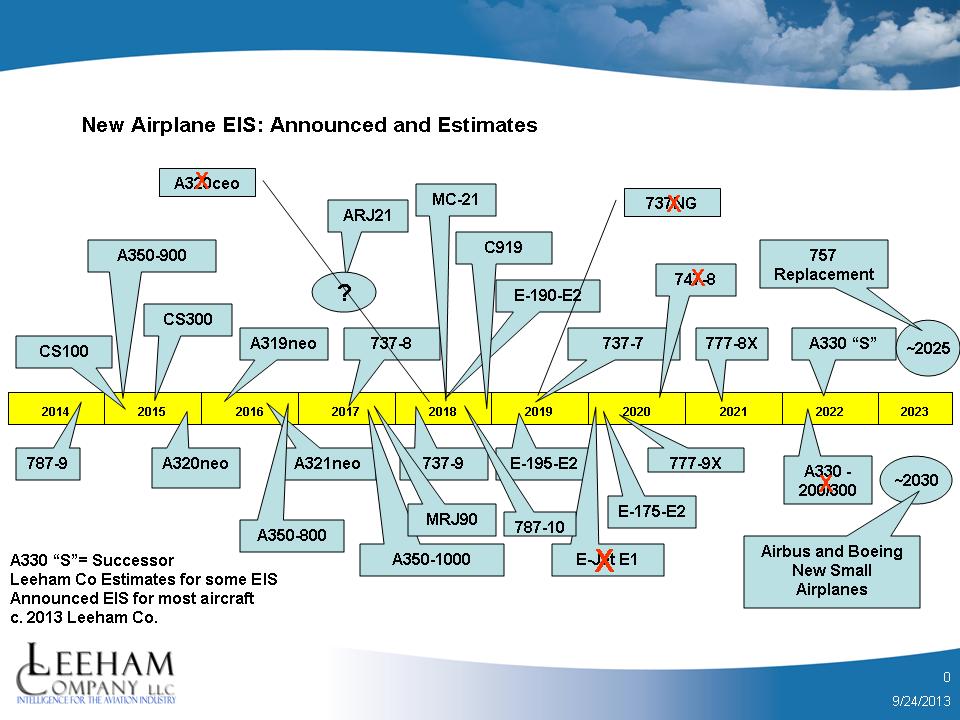
.
The arrows to certain points within years are not necessarily representative of specific timelines within that year. OEMs generally are not too specific about and EIS date, preferring to say “first half” or “second half” or some derivative of ambiguity. The only specific that we’re aware of is Boeing’s revised EIS of the 737 MAX, from 4Q2017 to July 2017. Although the Ascend data base is quite specific, we’ve not attempted to be highly specific in this chart. (Have we been specific enough about all this?)
Readers will note that we have the ARJ21 arrow going to a question mark. This airplane is already seven years late, and supposedly it’s going to enter service next year, but we aren’t banking on this at all. COMAC/AVIC, producer of the ARJ21, has a dismal record of meeting target dates. Accordingly, although COMAC now says the EIS for the C919 is 2017, we’ve got this in 2018–and even this is likely generous.
Lufthansa splits wide-body order between Airbus and Boeing
Lufthansa Airlines announced its long-expected wide-body order, for 59 Airbus A350-900s and Boeing 777-9Xs.
Airbus won a firm order for 25 with options for 25 more. Boeing’s press release didn’t disclose options.
This is a big win for both companies in a hard-fought contest. LH had long said it expected to buy only from one company, and the split order means neither OEM came away empty handed. But Boeing did not get an order for the 787-10, which was part of the package being offered to LH. Nor did it receive an order for the 747-8I, which it had hoped to obtain as well.
USAF considers scrapping KC-10 in sequester
KC-10 scrapping: The US Air Force is considering scrapping the KC-10 aerial tanker fleet as a result of budget cutbacks in the sequester, The Army Times reports. This is stunning news, considering the seven year battle to recapitalize the Boeing KC-135 tanker fleet.
There are 59 KC-10s, based on the McDonnell Douglas DC-10. McDonnell Douglas merged with Boeing in 1997.
Boeing one day hopes to develop a tanker based on the 777-200LRF to replace the KC-10 and we expect Airbus Military will offer the A330 MRTT or even a tanker based on the A350, but we certainly didn’t expect any prospect of retiring the KC-10 prematurely.
Replacing Air Force One: will 747-8 production remain open, or can 777-300ER become AF One?
Bloomberg has this story about the prospect of replacing Air Force One “early in the next decade.” Aviation Week has this story as well. The Aviation Week story links to the Dayton Business Journal, and reports that the USAF wants a commercial derivative, four-engine airplane for delivery in 2021 or later. This description, of course, says “Boeing 747-8” without saying so.
The assumption is that Boeing will provide the 747-8I (Airbus already said it will not bid the A380), but the timing could make it problematic. At August 31, there was a backlog of just 53 8Is and 8Fs, or 30 months at the current production rate of 1.75 per month–to 2016. Boeing has had several dry spells for orders. The 8I isn’t selling well at all and the cargo market hasn’t recovered yet, suppressing sales for the 8F. How does Boeing keep the 747-8 production going until delivery of Air Force One replacements “early next decade”?
Boeing has a couple of 8I campaigns we’ve heard about, hoping for orders this year. These include British Airways and Lufthansa Airlines and a third airline we haven’t yet identified. Lufthansa is expected to announce a wide body order any day now. The publicly acknowledged competition has been between the Airbus A350 and a combination of the Boeing 787-10 and the yet-to-be-launched Boeing 777X. But the 787-10 entry-into-service is planned for 2018 and the 777-9X in around 2020, followed a year later by the 777-8X. Airbus is believed to have delivery slots earlier that either Boeing airplane.
So what would entice Lufthansa to buy Boeing with the later delivery slots? According to our market intelligence, Boeing has offered LH the 747-8I at steep discounts to serve as an interim airplane. This not only would keep LH in the Boeing camp but would help keep the 747-8 production line open. An order from the second of the three airlines would also be needed in this scenario to keep the line open. These orders would also enable Boeing to avoid another write-off for the 747-8 program, our market intelligence says.
But does Air Force One have to be a four-engine airplane? The Secret Service reportedly demanded such when seeking a replacement for the Boeing 707, but according to Wikipedia, the USAF specified a plane with at least three engines and 6,000 mile range. Air Force Ones (there are two of them). When the RFP for the new AF One was issued, in 1985, twin-engine, long haul airplanes with ETOPS were still early in their service, eliminating the prospect for the twin-engine Boeing 767. The Secret Service was said to want more than two engines for safety.
But today, twin-engine ETOPS airplanes and the engines are incredibly reliable. The Boeing 777-300ER has a dispatch reliability second to none as far as we can tell and the GE90 engines that power it are superb. Could the Secret Service and USAF accept a 777-300ER bid? (We doubt the Secret Service or the USAF would accept the new, unproven 9X as Air Force One.)
The 777 certainly doesn’t have the panache of the 747, but operationally there certainly is nothing wrong with the airplane and engines and there is no question about the line being open to 2020 or even somewhat beyond.
The Air Force also needs to replace the 747-200 that serves as the flying command post for the President and the top military brass. This is the white 747 that was spotted over Washington (DC) on 9/11/2001, the day America came under airborne attack by Al Qaeda. But the news articles don’t mention replacing this aircraft.
Who needs a 747-8I? Air Canada puts 458 seats in 777-300ER
Holy crammed-in-coach, Batman!
Air Canada has configured its latest Boeing 777-300ER with 458 seats, in three classes. How in the world? Airline Reporter tells how, and we wouldn’t want to be stuck in coach.
We’ve been writing for some time the Boeing 747-8I is squeezed from the bottom by the -300ER and from the top by the Airbus A380, but this configuration on the -300ER is pretty extreme. Boeing claims seating of 467 for its 747-8I when it compares its Very Large Aircraft with the A380 (a configuration that is unrealistic–it should be 405 in typically airline layout).
Seatguru.com has this illustration of Air Canada’s -300ER seating.
Airline Reporter doesn’t say who makes Air Canada’s new coach seats. Recaro seems to be a popular supplier, providing its slimline seats to Qatar and Alaska Airlines, among others. We’ve been in Alaska’s Recaro-equipped coach class and while AS touts these as state-of-the-art comfort, we were less impressed. There was little lower back support unless sitting firmly in the seat, and the recline isn’t enough unless you slouch. The headrest is in the wrong position for good neck support (for a 6-footer). We also sat in Qatar’s Recaro coach seat when the airline showed its first Boeing 787 off to media and invitees, and we weren’t impressed then, either. Slimline design notwithstanding, it was still cramped. On the other hand, Qatar uses BE Aerospace-designed fancy business class seats and these were the first we’d seen where you don’t have to be an engineer to figure out the controls, figuratively speaking.
Since we started out with a Hollywood saying, we’ll end with one. Coach class on international flights, especially considering 17 inch wide seats and narrow seat pitch: as Danny Glover’s character in Lethal Weapon said, “I’m too old for this [stuff].”
Odds and Ends: 787 fulfilling dream; Weather worsens for CSeries; Painting out logos; plane vs car
787 Opens New Routes: The Boeing 787 is still getting some negative headlines about dispatch reliability, but the plane is proving Boeing’s underlying message about opening new, “thin” routes. The Tacoma News-Tribune has this story detailing how the 787 is fulfilling the dream (so-to-speak).
CSeries First Flight: The weather forecast in Montreal deteriorated further overnight. Now rain is predicted through Saturday, making first flight unlikely until at least Sunday.
Guess Whose Airplane? You’d never know from the titles and logo painted out, would you?
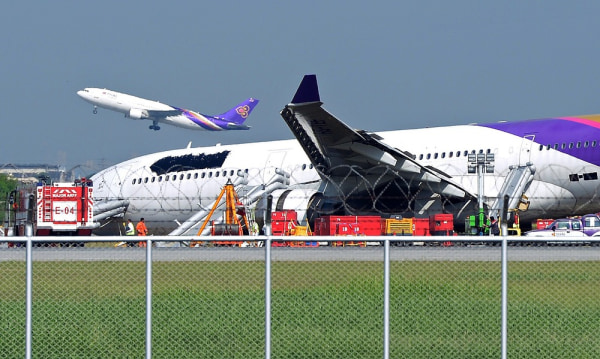
NBC News Photo
CNN has this story on the matter. This is the first accident in 12 years, according to Wikipedia when a crew member was killed in a fire that destroyed a Boeing 737 on the ground. The last accident involving passengers was in 1998, according to Wiki.
Speaking of Accidents: Here’s an unusual one: A Delta Air Lines commuter plane struck a car parked on the tarmac while the plane was being towed.

ClickonDetroit photo.
Let’s see the owner of the car explain this one to his insurance company.
Odds and Ends: S&P; C-17; AA-US merger (again); 777X wing work; WA aerospace future
S&P says don’t pay attention to our ratings: On the same day Delta Air Lines was named to the S&P 500, The Los Angeles Times had this article commenting on Standard & Poor’s legal defense of its investment grade credit ratings of companies involved in the 2008 financial collapse in the US that led to the global recession in 2008, affects of which are still felt today.
S&P’s defense included the argument that nobody should pay attention to its ratings, according to the article.
The ratings issue is important because airlines, lessors (and, of course, others outside aviation) covet investment grade ratings for the capital-intensive aerospace industry. Airlines and lessors need “cheap” money to buy airplanes. Air Lease Corp recently obtained its first investment grade rating, for example, something for which it issued a press release. Delta gained headlines for its return to investment grade status. Airlines have long used S&P, Moody’s and Fitch for rating equipment trust certificates used to finance airplanes.
The columnist for the LA Times is incredulous that S&P’s legal defense in the federal lawsuit is, essentially, nobody should pay attention to its ratings. It is indeed remarkable.
Final C-17 for US Military: Boeing’s C-17 program has been struggling to stay alive for the past several years and the challenge will get worse when Boeing hands over the final order to the USAF. The airplane’s survival depends now entirely on non-US sales, and these come few and far between. It’s also the last program of McDonnell Douglas; Boeing killed the MD-11, MD-80, MD-90 and MD-95 lines not that long after the two firms merged, though it did keep the MD-95 alive for a short time, renamed the Boeing 717.
The Long Beach Press-Telegram has a couple of additional stories here and here.
Why States opposes AA-US merger: Micheline Maynard writes in Forbes why she thinks states have joined the US Department of Justice lawsuit to block the merger between American Airlines and US Airways. The actions have nothing to do with consumer protection, the alleged motive of the DOJ, she opines. Rather, the states’ interests are far more parochial.
ElectroImpact competes for 777X work: ElectroImpact makes wings for the Airbus A380 and A350 XWB and it’s headquartered in Boeing’s back yard at Everett (WA). Now it’s hoping to build wings for the 777X. This Seattle Times report tells the story.
Washington State’s future in aerospace: The Pacific Northwest Aerospace Alliance hosts its second annual series of luncheons with members of the Washington State Legislature to talk about what needs to be done for the future of aerospace in this state. The first lunch is in Bellevue (WA) September 24 and the second is September 26 in Spokane, the other major aerospace cluster in the state.
Confirmed Bellevue Panelists
• Sen. Nick Harper (D), District 38 – Everett
• Sen. Paull Shin (D), District 21 – Lynnwood
• Rep. Mike Sells (D), District 38 – Everett
• Rep. Bruce Chandler (R), District 1 – Yakima
• Rep. Larry Springer (D), District 45 – Kirkland
Confirmed Spokane Panelists
• Sen. Michael Baumgartner (R), District 6 – Spokane
• Rep. Timm Ormsby (D), District 3 – Spokane
• Rep. Kevin Parker (R), District 6 – Spokane
• Rep. Mark Schoesler (R), District 9 – Ritzville
Information and registration for Bellevue is here.
information and registration for Spokane is here.
Clever headline: The Street.com column has a clever headline this morning in a post written by Ted Reed concerning the on-going sales battles between Airbus and Boeing.