
Leeham News and Analysis
There's more to real news than a news release.


Pontifications: No engines, billions shy, devastating enviro analysis, Boom’s CEO still exudes optimism
By Scott Hamilton
Sept. 20, 2022, © Leeham News: Blake Scholl, the founder and CEO of Boom, the start-up company, continued to paint an optimistic picture about the Overture Supersonic Transport.
He told the US Chamber of Commerce Aerospace Summit last week that the Overture, a Mach 1.7 88-passenger aircraft concept, will revolutionize international air travel.
But Boom has big challenges ahead—not the least of which is that there is no engine manufacturer so far that has stepped up to provide an engine. The Big Three—GE Aviation, Pratt & Whitney, and Rolls-Royce—have either outright rejected participation or other priorities exist.
Plethora of Challenges
- Rolls says publicly it won’t pursue an engine for Boom. GE told LNA it’s not interested in developing an engine for Boom. P&W is focused on advances for its GTF, developing sustainable technology and military engines.
- The International Civil Aviation Organization (ICAO) in July issued a report on the environment that eviscerated SSTs and the SAF concept outlined for Boom. The report included analysis from the International Council on Clean Transportation (ICCT).
- Scholl claims a market demand for thousands of SSTs but Boom’s 2013 study by Boyd International forecast a market demand over the life of the program of 1,318 Overtures. Some thought this figure was generous.
- Boyd’s report also concludes Boom needs a Mach 2.2 airplane to be commercially viable. Scholl reduced the speed to 1.7. This means that in some cases, airline crews can’t do a round trip from the US to Europe without a relief crew, which upsets some of the economics.
- If Boom were a publicly traded company, all the orders would fall under the ASC 606 accounting rule that questions the viability of those orders.
- Scholl told AIN Online Boom needs $6bn to $8bn to come to market and so far, it has raised $600m.
- And we don’t get into the certification and regulatory hurdles. Among them: In his presentation to the Chamber, Scholl said there are 600 potential SST markets. He included some inland in the US, where there is a ban on SSTs flying over land.
Engine Development. Part 5. The Turbofans go High Bypass
Subscription Required
By Bjorn Fehrm
Introduction
September 15, 2022, © Leeham News: Last week, we looked at how Pratt & Whitney’s JT8D turbofan came to dominate short-haul airliners while the JT3D had the long-range market.
The introduction of the widebody jets in the 1970s with Boeing 747, Douglas DC-10, and Lockheed Tristar brought GE and Rolls-Royce into the market. It was the start of the high bypass turbofans.

Figure 1. The roll-out of the Boeing 747-100 on September 30, 1968.
Summary
- The military TF39 for Lockheed C-5 Galaxy military transport set the benchmark for the new generation of high bypass turbofans with its 8-to-1 bypass ratio.
- Pratt & Whitney, GE, and Rolls-Royce developed civil engines along the lines of the TF39 for the new generation widebodies.
Engine Development. Part 3. The early turbofans.
Subscription Required
By Bjorn Fehrm
Introduction
September 1, 2022, © Leeham News: Last week, we looked at the motivation to change from propeller engines to jet engines as higher cruising speeds were sought for airliners.
We learned the straight jet engine, while good for military jets, wasn’t well suited for civil airliners. It was noisy and fuel-thirsty. It was why the subsequent engine development, the turbofan, was quickly accepted by the airlines.
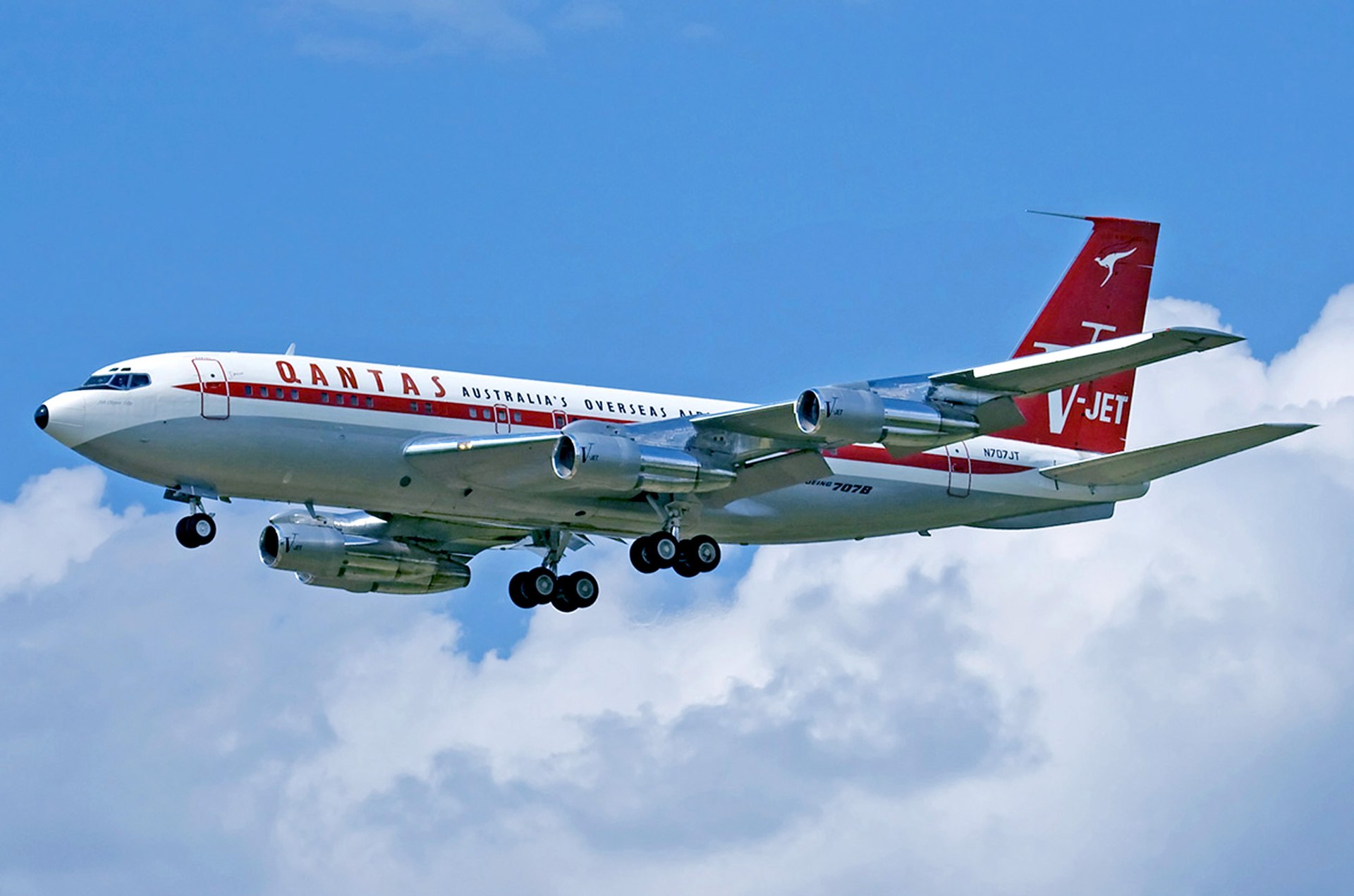
Figure 1. A Boeing 707 with Pratt & Whitney JT3D turbofan engines. Source: Wikipedia.
Summary
- The first turbofans from Rolls-Royce, Pratt & Whitney, and GE had different designs.
- The advantages of the turbofan over the straight jet were quickly recognized. The turbofan has been the choice for airliners since the late 1950s.
Engine Development. Part 2. The early jet engines.
Subscription Required
By Bjorn Fehrm
Introduction
August 25, 2022, © Leeham News: Last week, we started a series about jet engine development for our air transport aircraft. The jet engine came to replace the piston and gas turbine propeller engines when airplanes sought higher cruising speeds.
In the second part of the series, we look at why the jet engines were developed and their advantages and disadvantages compared to what they replaced.
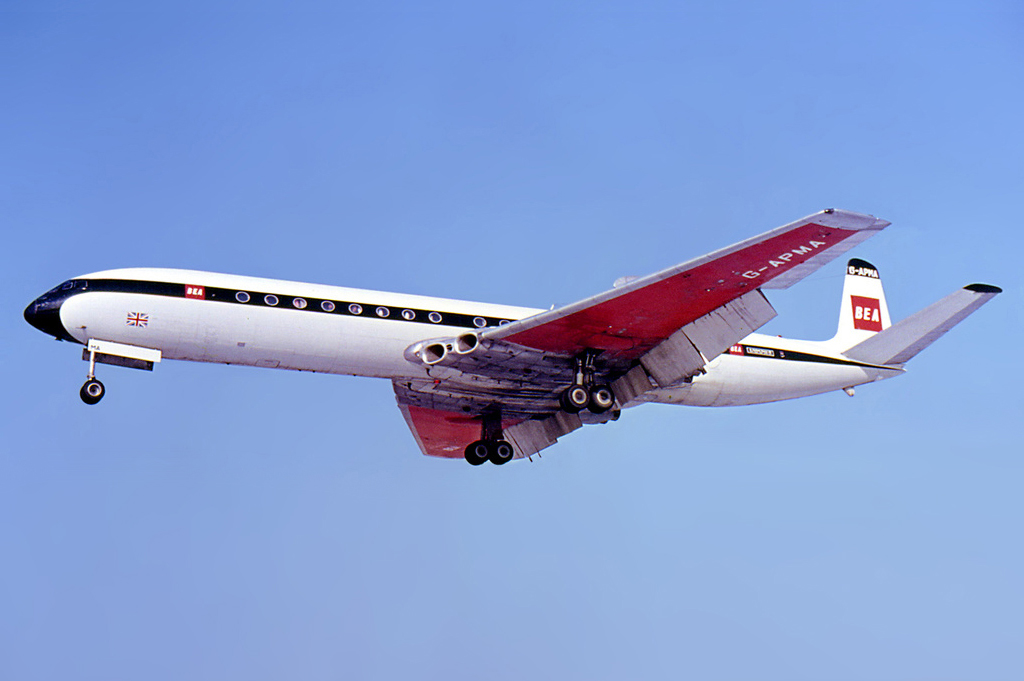
De Havilland Comet, the first jet airliner. Source; Wikipedia.
Summary
- When the propeller engine came to its speed limits, the straight jet engine was the answer.
- While it helped with speed, it created other problems.
Engine Development, Part 1: Launch to Entry into Service
Subscription Required
By Vincent Valery
Introduction

Pratt & Whitney Geared Turbofan
Aug 18, 2022, © Leeham News: LNA analyzed the evolution of commercial aircraft development timelines last month. The time between a program launch and entry into service significantly increased over time, including for derivatives.
The increase in development time is primarily the result of more complex and safer airplanes. Introducing new materials, notably a more extensive use of composites, also explain longer development timelines.
LNA now starts a new series on the topic of commercial aircraft jet engines. The goal is to go through significant innovations from the beginning of the jet age.
This first article analyses whether engine development time between launch and entry into service increased significantly over time.
Summary
- Military development led to the first commercial jet engines;
- The divergence between military and commercial programs;
- Pushing the envelope of the same fundamental engine architecture;
- Harder to identify development timeline evolution.
How Boeing is Rebuilding Engineering Excellence
Subscription Required
By Bjorn Fehrm
Introduction
June 9, 2022, © Leeham News: As described in our Monday article, Boeing is preparing for its Next Boeing Airplane (NBA). At the same time, the company is hard at work to ensure this will be no repeat of the 787 and 737 MAX program debacles.
The 2022 Chief Aerospace Safety Officer Report was issued two weeks ago. It gives insight into the work that shall ensure such failures won’t happen again. Here is what the report says about how Boeing is rebuilding its Engineering Excellence.
Summary
- The 787 and 737 MAX failures came from a company culture where engineering excellence played second fiddle to short-term business objectives.
- Boeing has now made changes from the board level to how it organizes its engineers. These changes go in the right direction, but will they be enough?
Bjorn’s Corner: Sustainable Air Transport. Part 16. Thrust generation
April 22, 2022, ©. Leeham News: Last week, we examined propulsion system alternatives and their principal advantages and disadvantages. Now we go deeper into these alternatives.
All propulsion systems for aircraft use a propulsion device like a propeller or a fan to generate forward thrust. We use this article to understand how these work and their characteristics before we go into how we create the shaft power to drive them.
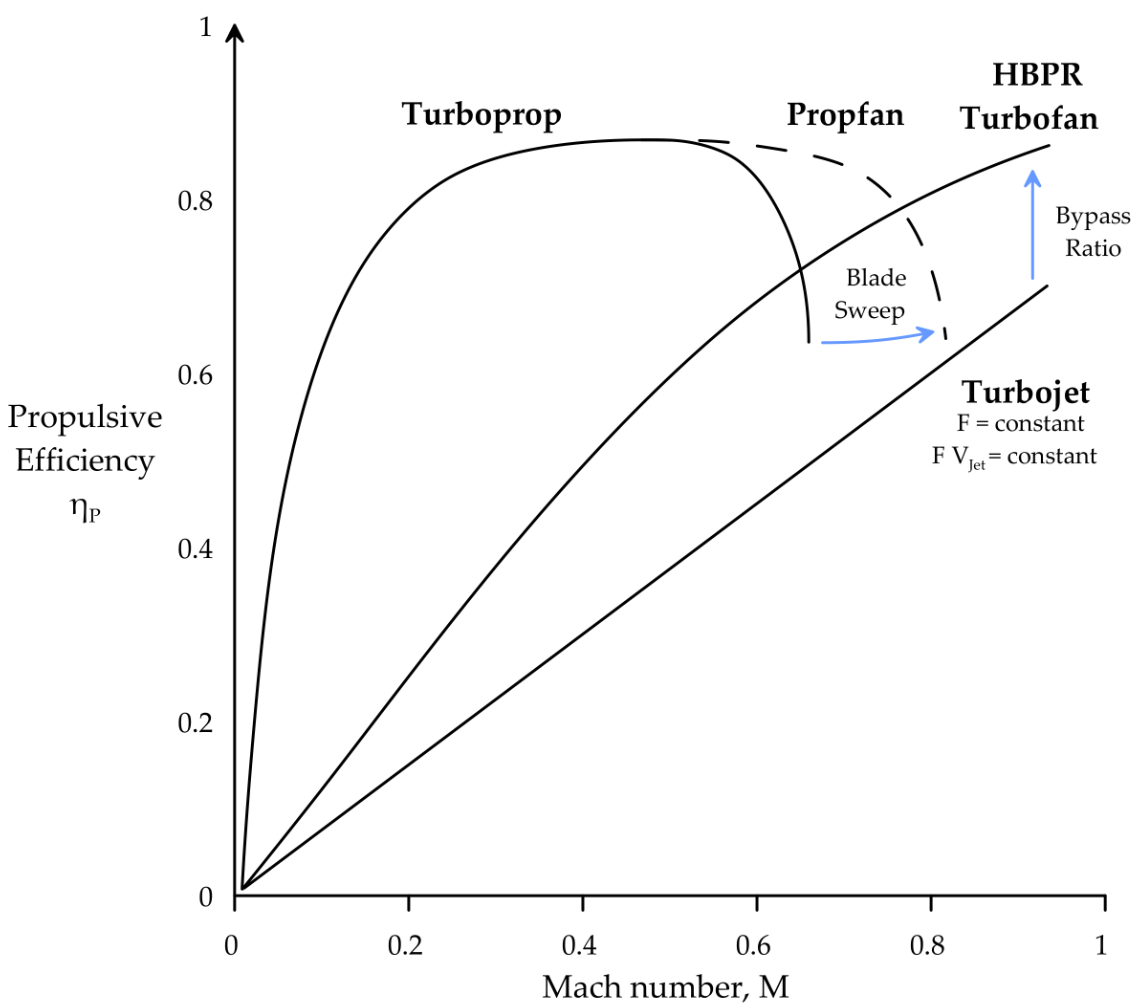
Figure 1. The propulsive efficiency as a function of speed for different thrust generating concepts. Source: Aircraft propellers, is there a future? MPDI document.
Pontifications: The soup du jour
March 14, 2022, © Leeham News: You might call it the soup du jour.
By Scott Hamilton
EcoAviation is all over the place at aviation conferences these days. It was a key topic at last October’s Annual General Meeting of the International Air Transport Association (IATA). Likewise at last month’s annual conference of the Pacific Northwest Aerospace Alliance (PNAA). EcoAviation also was an element of the Speed News conference in Los Angeles early this month and at another event the following week. Investor Day events now routinely include ecoAviation discussion.
This is all well and good, but at last, some key members of the industry are putting caution and realism to the pie-in-the-sky stuff that is sucking up investment like the Dot Com era a few decades ago. Only a few ideas and technologies will be successful.
A Boeing 787-10 HGW, how good is it?
Subscription Required
By Bjorn Fehrm
Introduction
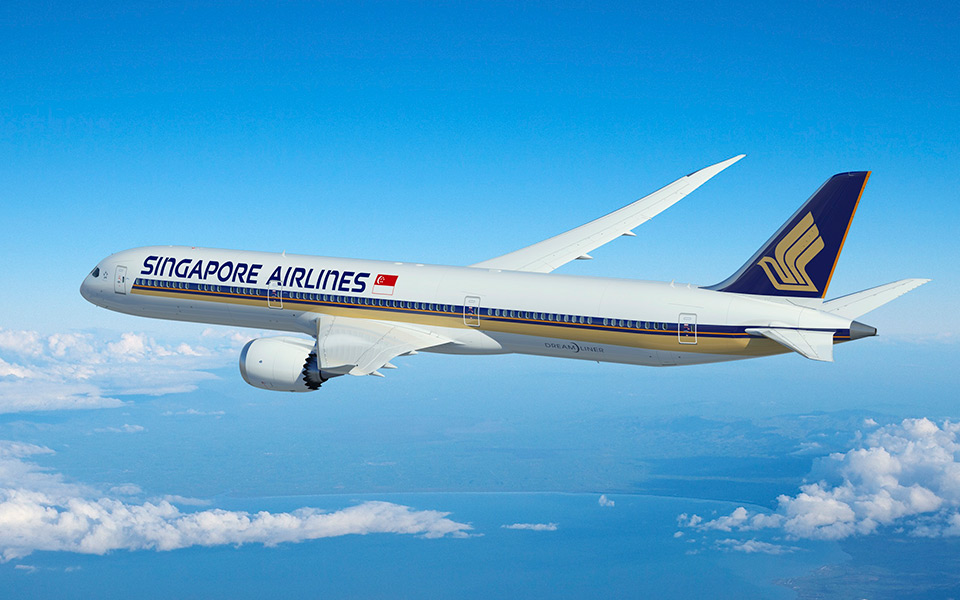
February 24, 2022, © Leeham News: The CEO of Boeing Commercial Aircraft (BCA), Stan Deal, said at the Singapore Air show the company worked on increased gross weight versions of both the 787-9 and -10.
Target is to get the 787-10 to the range of the aircraft it shall replace, the 777-200ER and -300ER. It means more than 7,000nm of range against the 6,400nm of today.
How many tonnes of increased Gross weight does this mean, and what would be the performance compared with the Airbus A350-900? We use our airliner performance model to find out.
Summary
- The 787-10 can grow to a range of over 7,000nm with a modest increase of its gross weight.
- It will be competitive with the A350-900 but for the longest routes in such a variant.
For next new airplane, Pratt appears to trail CFM for next new engine
Subscription Required
By Scott Hamilton
Feb. 21, 2022, © Leeham News: As Boeing ponders whether to launch a new airplane program and industry consensus seems to be that this must happen in 2023 or 2024, Pratt & Whitney seems to face a dilemma.
Pratt & Whitney Geared Turbo Fan engine. Credit: Pratt & Whitney.
Convinced that the Geared Turbo Fan technology is the path to future engines, nevertheless, public statements indicate that by 2035, the GTF in the conventional form will fall short of the Open Fan being developed jointly by GE Aviation and Safran. GE and Safran are 50-50 partners in CFM International, which will sell the engine.
Rick Deurloo, the chief commercial officer for PW, told LNA last October that by 2031 (at the time, 10 years in the future), the GTF will have a 10% improvement in fuel burn and emissions compared with today’s GTF. PW will have a 1% improvement by 2024.
GE’s Travis Harper, who is the program manager for the Open Fan “RISE” engine under development, told LNA earlier this month that the RISE will reduce fuel consumption and emissions by 20% and be ready for entry into service by 2035.
If the goals outlined by Deurloo and Harper are taken at face value and achieved, this means the GTF will be up to 10% short of CFM’s engine ready for EIS four years later.
This was the question LNA put to other representatives of GE and PW at the Pacific Northwest Aerospace Alliance conference Feb. 10.