
Leeham News and Analysis
There's more to real news than a news release.


Airbus formally launches A321LR; we look behind the “LR” to see what’s there
15 Jan 2015: Airbus officially launched what to date has been called A321neoLR as the A321LR at their annual press conference Tuesday. The former A321neoLR name was formed by Leeham News on 21 Ocober 2014 when we could reveal the existence of a A321neo variant which Airbus had started to present to airlines at the time. The final name kept the LR attribute used in the article to distinguish the longer range variant from the standard A321neo.
The A319 has used the LR designation but its use has been limited. The suffix is more commonly identified with Boeing, used as it is with the 777-200LR. Boeing has also commonly used the ER for extended range like 777-200ER, 737-900ER and 777-300ER.
Airbus reveals record orders at annual press conference
By Bjorn Fehrm
Toulouse 13 Jan 2015: Airbus today held their annual press conference where they among other things revealed their final numbers for orders and deliveries. The press conference was hosted by Airbus CEO Fabrice Bregier accompanied by COO Customers John Leahy, new COO Tom Williams and new Head of Programs Didier Evrard.
Airbus in 2014
Bregier started with pointing out that 2014 was a very eventful year for Airbus. Airbus did their customary end of year sprint and passed Boeing for net orders with 24 aircraft netting 1456 commands, Figure 1.
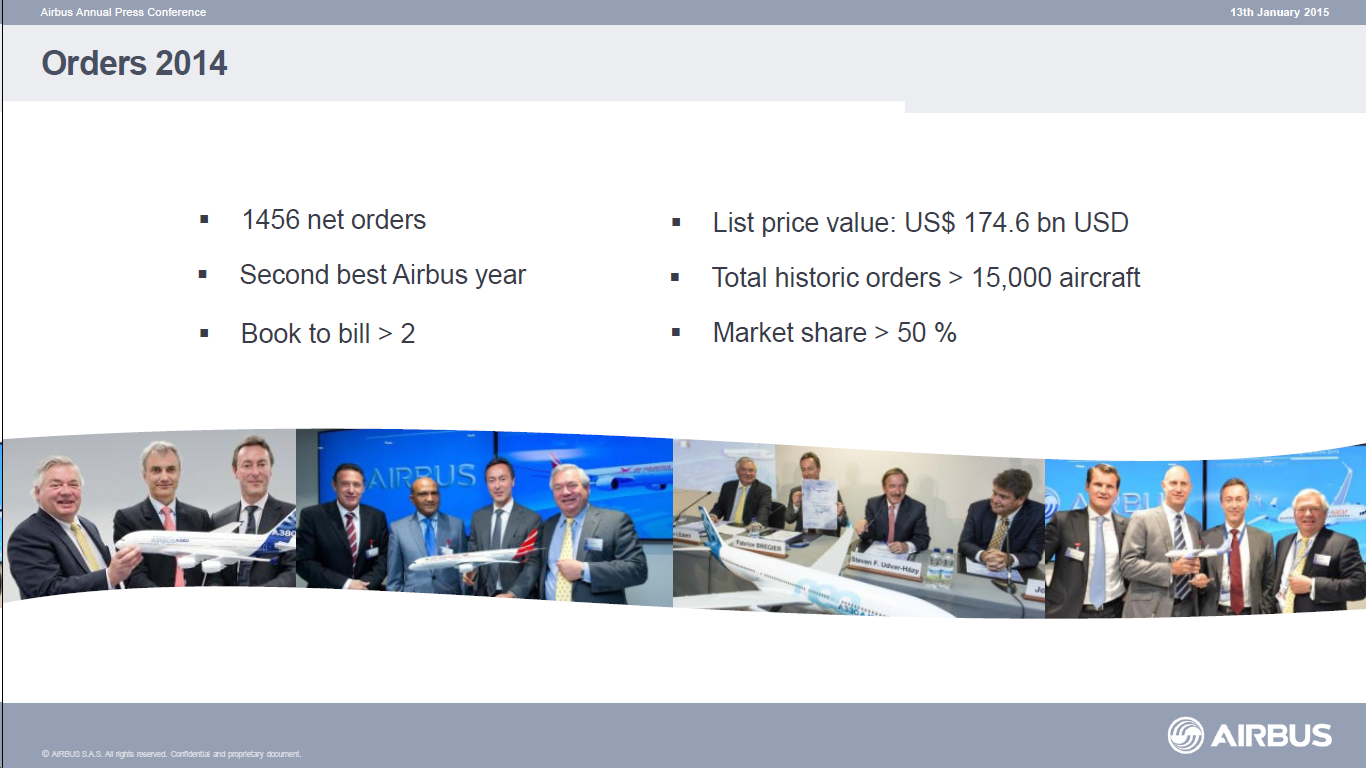
Figure 1. Airbus orders for 2014. Source: Airbus.
On the delivery side Boeing is ahead with 723 deliveries versus Airbus 629, Figure 2.
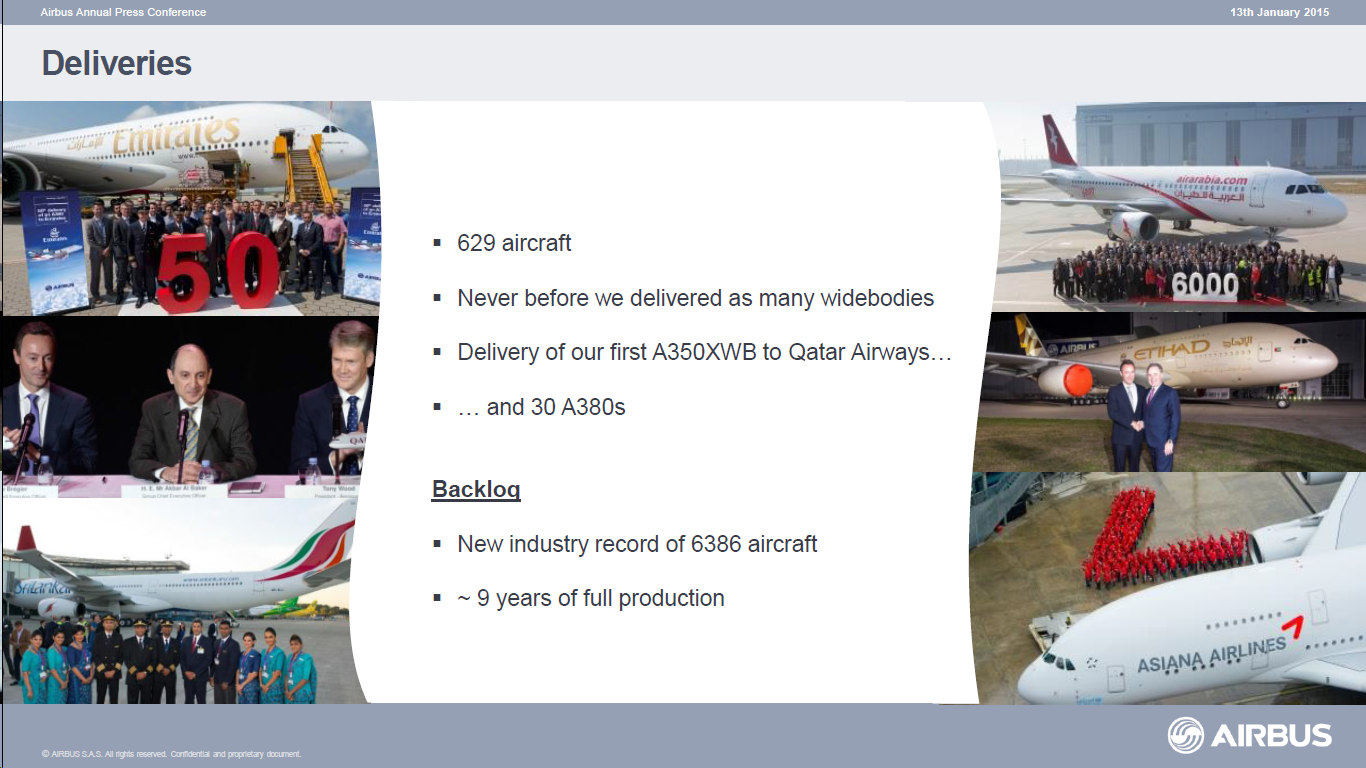
Figure 2. Airbus deliveries for 2014. Source: Airbus.
Further Airbus certified the A350 and delivered the first aircraft to its launch customer, Qatar Airways. It also launched the A330neo and got 120 orders during the year. Finally they flew the A320neo first prototype.
A380neo decision likely this year, triggering the next widebody engine project
Subscription required
By Bjorn Fehrm
Introduction
Jan. 12, 2015: One of the subjects which is sure to come up on Airbus annual press conference on Tuesday the 13th in Toulouse will be when and how Airbus will re-engine the A380.
Airbus Commercial CEO Fabrice Bregier vowed during the Airbus Group Global Investors Day last month that an A380neo is coming.
There is much speculation around this subject as the business case of re-engineering an aircraft that is selling at such low numbers is difficult to get to close. The business case is difficult to make work for Airbus (such a project will cost in the order of $2 billion) but it will be equally hard for the engine manufacturers to offer engines that have enough efficiency gain to make the overall project feasible from an efficiency improvement perspective.
Summary
- A380 Classic equals Boeing 777-300ER seat fuel costs.
- Boeing 777-9 beats A380 on CASM, an A380neo regains the advantage.
- Engine makers face hard choices to retain dominance or to broaden market penetration.

Fundamentals of airliner performance, Part 5; Approach and landing
By Bjorn Fehrm
Dec. 2, 2015: The time has now come to cover descent and landing in our articles around airliner performance. As many aspects of descent are similar to climb we will repeat a bit what we learned in Part 4:
- For high speed operation the pilots fly on Mach as this gives him maximum information around possible effects on the aircraft when he is close to the high speed limit, the maximum Mach number. Beyond this the aircraft gets into supersonic effects like high speed buffeting or unsteady flight.
- For operations under the cross over altitude for Mach 0.78 to 300 kts IAS the pilot flies on Indicated Air Speed (IAS) which gives him maximum information how the aircraft reacts should he go close to the aircraft’s lower speed limits.
Lets now start to go through the steps that our 737 MAX 8 performs after leaving its cruise altitude.
Happy Thanksgiving, 2014
Today we’re watching the Seattle Seahawks…Go Hawks!
We’re off until Monday.

Fundamentals of airliner performance, Part 4
By Bjorn Fehrm
Nov. 25, 2014: In our article series around the performance of a modern airliner we have now come to the climb after takeoff. We started with cruise as this was simplest because the aircraft is flying in steady state, then we looked at the modern turbofan and how this is affected by both altitude and speed. We then examined how this affects the takeoff and today we continue with the climb after takeoff.
Before we start, let’s sum up a few points we need for today:
- Drag is the one thing we always need to be aware of as this regulates how much excess power we have in different flight situations and therefore if we can stay on our altitude or climb.
- Drag diminishes with altitude as the airs density diminishes and thereby our dominant drag component, air friction against our aircraft’s skin. This is the major component of the aircraft’s dominant drag, parasitic drag.
- Our lift force is generated by forcing air downwards and this causes induced drag as this downwash cost energy to generate and maintain. Induced drag is mitigated by a wing with a large span.
Zhuhai airshow: Airbus gains A320 MOU while regional A330 needs explaining
The Zhuhai airshow has not brought the expected slew of announcements from Western aircraft manufacturers. Boeing announced an order for 80 737 MAX Monday but this was characteristically from a leasing company across the Chinese see, SBMC Capital of Tokio.
Airbus on the other hand has not been able to move the much talked about A330 regional to order yet, despite announcing it in China last year and enticing with an announcement for a Chinese completion center for the aircraft before the show. Flightglobal reports that the A330 regional needs further explaining, Chinese carriers seems hesitant to buy what Boeing pitches as “obsolete technology” in a weight variant that only could fly local missions.
Airbus China president Eric Chen explains that the 200t variant is not constrained to Chinese mainland and can fly any missions that its range would allow. He also points out that the weight variant is just that, a de-papered weight version that can be upped to whatever take off weight the customer wishes at a later date by paperwork changes (and perhaps some additional galley equipment). As for technology level, an aircraft shall be valued for its contribution to a carriers business says Chen, not by which years it says on its airworthiness certificate.
The smaller A320 did not disappoint reports Aviation Week, Airbus CEO Fabrice Bregier could announce a Memorandum Of Understanding (MOU) for 100 A320 from state affiliated China Aircraft Leasing whereof 74 would be A320neo. The order, once confirmed, can help Chinese carriers with the aircraft demand for the 2016-2020 economic planning period. Chinese carriers have been slow to place the necessary early OEM orders for the period (needed due to the large backlogs), the lessor sees it can back-fill that demand when the carriers comes around to needing the aircraft.
Airbus also has explaining to do in other corners of the world, Emirates intend to start second round talks around A350 in the next months according to Reuters. The first round of 70 aircraft was cancelled after Emirates did not understand a specification change that Airbus undertook without consulting Emirates. This time Emirates will see the aircraft flying with neighbor Qatar Airways before agreeing to any specifications according to Emirates CEO Tim Clark.
Fundamentals of airliner performance, Part 2.
By Bjorn Fehrm
In our first article on how to understand the fundamentals that make up airliner performance we defined the main forces acting on an aircraft flying in steady state cruise. We used the ubiquitous Boeing 737 in its latest form, the 737 MAX 8, to illustrate the size of these forces.
Here a short recap of what we found and then some more fundamentals on aircraft’s performance, this time around the engines:
When flying steady state (Figure 1) we only need to find the aircraft’s drag force to have all important forces defined.
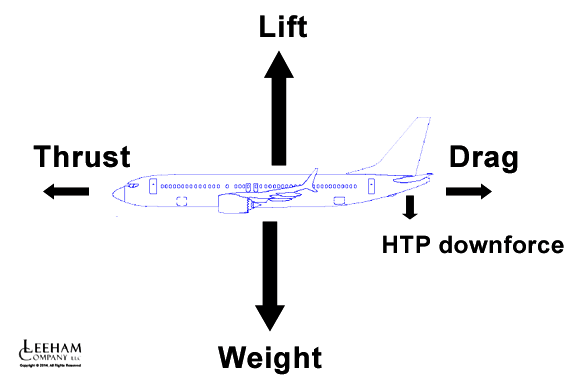
Figure 1. Elementary forces acting on an aircraft at cruise. Source: Leeham Co.
The lift force is given as equal to and opposite to the aircraft’s weight and the tail downforce that we need to add to this was small. We also presented the two classes of drag that we will talk about:
- Drag independent of lift or as we often call it drag due to size as almost all drag components here scale with the aircraft’s size.
- Drag due to lift or drag due to weight as we call it as this drag scales with weight when one flies in steady state conditions.
We could see that the aircraft’s flight through the air created a total drag force of 7900 lbf, Figure 2 ( lb with an f added as we prefer to write it as this is a force and not a measure of mass. Mass we denote with just lb or the metric units kg or tonne = 2205 lb).

Figure 2. Drag of our 737 MAX 8 and how it divides between lift and non lift drag. Source: Leeham Co.
We also learned that if the drag is 7900 lbf then the engine thrust is opposite and equal. It is then 3950 lbf per engine when cruising at our mean cruise weight of 65 tonnes or 143.000 lb on our 1000 nm mission. Drag due to size consumes 63% of our thrust and drag due to weight 37%. Read more
Fundamentals of airliner performance, Part 3
By Bjorn Fehrm
In our first article about how to understand the performance of a modern airliner we defined the main forces that are acting on an aircraft flying in steady state cruise. In our clinic we use the ubiquitous Boeing 737 in its latest form, the 737 MAX 8, to illustrate our case. In the second article we introduced the aircraft’s engines and understood how they function by pumping air backwards faster than the aircraft’s speed and therefore generating thrust as air is in fact quite heavy. We also looked at the influence of flight altitude on the performance of the aircraft.
In short we can conclude our findings so far:
Having covered the most important aspects of cruise we will today look at takeoff, a subject with a lot of aspects. Read more
Leave a Comment
Posted on November 19, 2014 by Bjorn Fehrm
Boeing, CFM, Leeham News and Comment, Uncategorized
737 MAX, Boeing, CFM, CFM Leap-1B