
Leeham News and Analysis
There's more to real news than a news release.



Thoughts for Seattle’s KOMO TV
Personal note:
I’m down at ISTAT in San Diego and have just learned of the crash of a KOMO TV News helicopter in Seattle, killing two and critically injuring one. The names haven’t been released yet, so I don’t know if I know them.
But I do know many of the people at KOMO. Being based in Seattle, I occasionally appear on KOMO as a talking head on aerospace issues.
My thoughts go out to the KOMO family.
Scott Hamilton
Odds and Ends: MH370 ACARS and landing areas
There continues to be mystery shrouding the disappearance of MAS flight MH370 and with it, loads of theories.
There is also continuing puzzlement over how the ACARS health monitoring system could have been turned off. We reported last week that simply flipping a switch could do so while other suggest it is far more complicated.
We once more turned to a Boeing 777 pilot/instructor to revisit this. His reply:

It’s all well and good to put this together, and to suggest the plane landed at some field–but then what? How do you hide a Boeing 777 from satellites photography? If the airplane is to be refueled for future use, how do you service it (i.e., get enough fuel to a remote, undisclosed location to refuel it)? If you landed on a short strip, you likely need a lot of skill to take off again (see the Boeing Dreamlifter that landed a the wrong airport in Kansas), which suggests this would be beyond a “mere” hijacker.
We continue to believe the airplane crashed, or was crashed, into the ocean.
Airbus and Boeing square off at ISTAT
Andy Shankland, senior vice president of leasing markets for Airbus, and Randy Tinseth, vice president of marketing for Boeing, were next up at the ISTAT annual meeting in San Diego today.
The following is a synopsis and paraphrasing of their presentations and free-wheeling discussion.
CIT Aerospace looks at A330 future
CIT Aerospace, one of the Top Tier lessors in the business, takes a look at the future options of the Airbus A330.
In a short paper released concurrent with the start of the AGM of ISTAT, the International Society of Transport Aircraft Traders, in San Diego today, CIT’s Steve Mason outlines what he sees as the options facing Airbus to improve sales.
The four page PDF may be found here.
We have production rates of 14 Boeing 787s a month (vs 16 in the CIT analysis) and 10 Boeing 777Xs a month (based on Boeing’s own information) vs eight in the CIT analysis, but otherwise the CIT analysis is very similar to the issues we’ve written about here previously, so we won’t repeat them. We presented yesterday to the ISTAT Appraisers Continuing Education meeting about the production gap facing Airbus, Boeing and Embraer between their current airplanes and future programs, a topic we’ve also discussed here previously. CIT and we concur that Airbus has a major dilemma with the A330 going forward; we believe Airbus should proceed with the A330neo, which should extend the life of the airplane by 10-15 years. Absent this, we believe Airbus will be at a major production rate disadvantage in the important 210-400 seat twin aisle sector.
Bombardier CSeries delays have little impact vs competitors
Bombardier’s third CSeries Flight Test Vehicle finally became airborne March 3. FTV 3 focuses on avionics. FTV 4 will focus on the testing of the Pratt & Whitney Geared Turbo Fan engine; Bombardier hasn’t announced a date when this airplane will join the test program.
Bombardier’s rescheduled flight test schedule, reflecting a 9-15 month additional delay to entry-into-service (now the second half of 2015), hasn’t been publicly detailed. BBD presents to the International Society of Transport Aircraft Traders (ISTAT) at its annual US meeting this week in San Diego, and there is an investors day later in the week. We expect one or both venues to provide program updates.
The new EIS narrows the gap between the CSeries and its competitors, the Airbus A319neo, the Embraer E-190/195 E2 and the Boeing 737-7 MAX. But the impact isn’t significant, in our view. Airbus’ A319neo—the direct competitor to the CS300—was to be the first of the re-engined challengers to the new-design CS300 with an EIS originally set for the first quarter of 2016 (six months after the A320neo EIS of October 2015). But Qatar Airways, the launch customer of the A319neo, dropped this order in favor of the larger A320neo. The A319neo EIS is now slated for the second half of 2017, for Avianca Airlines.
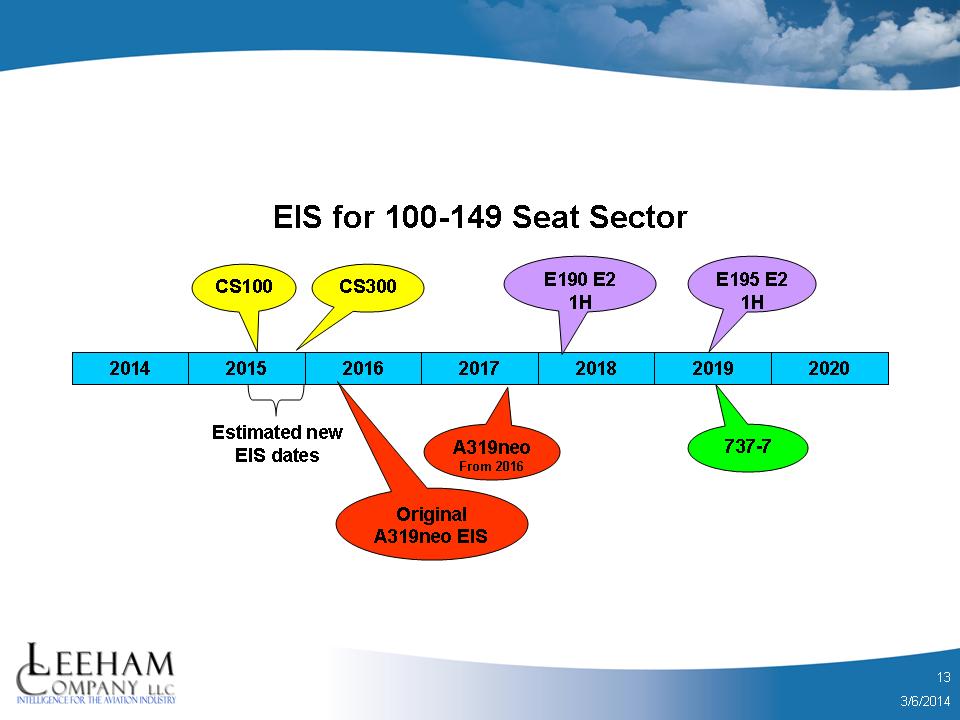
This means the original two-year gap between the CS300 and the A319neo remains the same, assuming no additional delays for the CSeries and none for the A319neo.
Parenthetically, we are unsure if Frontier Airlines will take its order for 20 A319neos, with first delivery scheduled in 2018. When we talked with CEO David Siegel two years ago, he expressed doubts about taking the airplane, preferring the larger A320 sibling. The only other announced customer is Avianca, with a firm order for nine. Will Avianca ultimately take the A319neo, particularly if Frontier swaps its order? We have our doubts. There is an unannounced customer for the A319neo for eight, according to the Ascend data base, but delivery dates currently are listed as “2500.”
The Embraer E-190 E2 nominally competes with the CS100; it’s barely within the 100-125 seat category in a one-class configuration, while the CS100 is comfortably within this sector. In two classes, the E-190 E2 is an 88 seat aircraft and the CS100 is 100 seats. The CS100 also has more range; arguably these are different classes of aircraft.
The E-195 E2 nominally competes with the CS-300. In one class, the E-195 E2 is a 132 seat airplane, but the CS-300 carriers 145-149 passengers, and as with the CS-100 has longer range. The E-195 E2 is a more direct competitor with the CS-100, but range is shorter and missions may be somewhat different. The EIS for the CSeries vs the E2s still has a gap of 2 ½-3 ½ years, assuming no delays to either program based on the currently announced schedules.
The 737-7 MAX EIS is slated for 2019, about four years after the CS-300.
Thus, we see little impact to Bombardier’s delay from a practical standpoint.
Despite the additional delay, Bombardier hasn’t yet updated its expectations for firm orders and customer numbers. It’s still reporting its goal to have 300 firm orders and 20-30 customers by EIS (previously fall of 2014). Moving the EIS to the right by 9-15 months should implicitly infer higher numbers. Perhaps new targets will be revealed in the program update this week.
MH370, Day 7: Malaysian authorities’ latest statement
We’ve been provided the latest statement from the Malaysian authorities, from which news reports have been written. We find the information in the statement to be more than a little interesting, so we’re reprinting it verbatim.
Official statement:
MH370 Day 6: tracking the missing flight
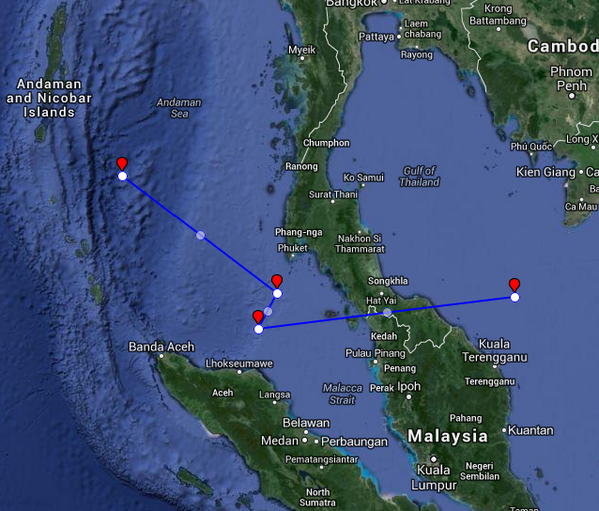
We don’t have anything to add today to the self-explanatory news in the last 24 hours that electronic signals tracked Malaysian Airlines flight MH370 and this is increasingly being viewed as a criminal act.
This graphic is worth reproducing here, based on a Reuters article and published on Twitter, depicting the route of the airplane.
MH370, Day 5: 777 has five radios, two transponders
The Boeing 777 is equipped with five radios and two transponders, making it next to impossible for failures to be due to electrical or other mechanical failures, a Boeing 777 captain and training instructor tells us.
The ACARS system, which communicates with the ground, is run off one of three VHF radios; the radio would have to be turned off (or failed). There are two HF (High Frequency) radios as well.
The two transponders, which identify the airplane to Air Traffic Control, are not operational simultaneously. If one failed, the pilot has to turn the other on as back-up, says George Nolly, a former airline pilot and Boeing 777/787 instructor.