
Leeham News and Analysis
There's more to real news than a news release.


UTAS sees increasing electronic architecture in future airplanes
Subscription Required
Introduction
 June 9, 2016, © Leeham Co.: The debate continues whether the next new, clean-sheet airplane will be a Middle of the Market aircraft (MOMA) or replacements for the Airbus A320 and Boeing 737 families.
Along with he studies of new airplanes are those undertaken by suppliers. Electric Systems, a unit of United Technologies Aerosystems (UTAS), is working with the OEMs to determine what level of electric systems will be used in the new aircraft, whatever is selected to go next.
Summary
- Electric systems on the Boeing 787 are up to 80% more efficient than those on the Boeing 777 Classic.
- The 777X retains the Classic systems or commonality.
- Benefits decline the shorter the flight.
Irkut MC-21 rolls out
June 9, 2016: Irkut rolled out its challenger to the Airbus A320 and Boeing 737-800/8

MC -21 rollout. Photo: AIN Online via Google images.
yesterday the MC-21-300.
The new airplane is powered by either the Pratt & Whitney GTF or a Russian engine. A report from a Russian-sponsored media site is here.
LNC previously published an analysis of the economics of the MC-21 behind our paywall. We’ve opened up the first of four parts to all readers here.
UTC media day 2: GTF hits 99.5% dispatch reliability rates
June 7, 2016: The new Pratt & Whitney Geared Turbo Fan, on seven Airbus A320neos,

Bob Leduc, president of Pratt & Whitney.
have achieved more than 2,000 revenue cycles with no returns or rejected take-offs, says Bob Leduc, president of Pratt & Whitney. The engines have a 99.5% dispatch reliability. The last time this level was achieved was with the introduction of the Boeing 777, which at the same point had a 100% dispatch reliability rate.
Wells Fargo sees reasonable, risky production rates
June 7, 2016: Single-aisle production rates of 57/mo at Boeing and 60/mo at Airbus are reasonable when achieved in the near term but more problematic in 2019. Wide-body production rate hikes are risky.
This is the conclusion of a short research note issued June 1 by Wells Fargo Securities.
“Higher Rates Sustainable,” WFS writes. “Aircraft deliveries have historically been cyclical, yet Boeing and Airbus have had flat-to-rising deliveries for 12 years–and both forecast higher near-term deliveries. The bottom line is that the OEMs’ forecasts can be reasonable in our view, assuming aircraft retirement levels and/or traffic growth are above historical rates. Therefore, we expect higher deliveries over the next several years, but think it is unlikely that the full 35-40% A320/737 production increase currently envisioned by the OEMs will be achieved by 2020.”
UTC media day 1: UTAS, twice the size of any other aerospace systems company
Note: United Technologies Corp (UTC) is holding its annual Media Days today and tomorrow. We’re providing reporting from the event. This is the first time in our long participation that UTC Aerospace Systems is presenting. UTAS is a major supplier and service provider to all the airframe OEMs.
June 6, 2016: UTC Aerospace Systems is just four years old, following mergers with

Dave Gitlin, CEO of UTC Aerospace Systems (UTAS).
Hamilton Sundstrand and Goodrich–the largest in aerospace history, says Dave Gitlin, president of UTC Aerospace Systems.
UTAS provides electrical power and bleed air systems, engine, starters, power systems, all the circulating fans on the Boeing 787, monitoring systems and much more. Evacuation slides, the Ram Air Turbines, landing gear, flaps and slat control systems, brakes and thrust reversers.
Pontifications: The Bottom Line isn’t always about The Bottom Line

By Scott Hamilton
June 6, 2016, © Leeham Co.: Sweetheart deals to win strategic aircraft orders are nothing new in commercial aviation.
John Leahy, COO-Customers for Airbus, last week poked Bombardier for its order from Delta Air Lines. Citing a reported airplane sales price of $22m, which Leahy estimated cost BBD $7m per airplane, Airbus’ chief salesman—known for his barbs and quips—said if BBD sold more C Series faster, the company would go out of business quicker.
Set aside for the moment the numbers he cited as unknown quantities. LNC has different figures we’ve reported and in two posts on my column at Forbes, here and here, there are other aspects to the Delta deal that affect economics.
It’s undisputed that BBD took a US$500m charge against the Delta, Air Canada and AirBaltic deals. The second Forbes post explains why. It’s all about the learning curve. Airbus and Boeing know about this: the first A350s are being chalked up to big losses and the 787 has $29bn in production costs. But it’s not to their benefit to acknowledge this when criticizing the C Series deals.
All this is neither here nor there, however. Airbus, Boeing and McDonnell Douglas all have (had) done deals that don’t seem to make commercial sense when key, strategic transactions were necessary.
Airbus stepping up innovation
By Bjorn Fehrm
Subscription required
Introduction
June 6, 2016, ©. Leeham Co: In January last year I had a discussion with Airbus CEO Fabrice Bregier regarding the innovation level at Airbus. The background to the discussion was that Airbus was trailing its direct competitor, Boeing Commercial Airplanes, in innovations since the early 2000s.
Airbus started life as a more innovative company than Boeing. It was using new technology in an aggressive way to gain product advantages on the incumbent Boeing. Examples are the universal use of Fly-By-Wire (FBW) and the standardization on a common cockpit layout for all its aircraft, whether single or dual aisle, Figure 1.

Figure 1, Airbus A320 cockpit laying the ground for a common cockpit standard. Source: Wikipedia.
The FBW and common cockpit enabled customer pilots to cover a wider range of aircraft with minimal training. Airbus also led the aerodynamic development with high aspect ratio wings for its A320 and A330/340 series aircraft.
Somewhere during the problems with the A380, the creative and innovative spirit got caught in the aim to unify the group, to make sure that the “I make it my way” initiatives stopped in the different national industries that made up Airbus.
Boeing: no new technical issues with KC-46A

Dennis Muilenburg, CEO of The Boeing Co. Boeing photo.
June 2, 2016: Boeing is not discovering more technical issues with the KC-46A, but recent issues relating to the refueling boom and wing pods are being worked through while concurrent production progresses.
“As we discover things in flight tests, we have to roll them into the airplanes. This will be a wide-body program for decades,” he said, forecasting sales of 400 tankers, said Dennis Muilenburg, CEO of The Boeing Co., speaking at the Bernstein Thirty-Second Annual Strategic Decisions Conference 2016.
Airbus aircraft programs in review
By Bjorn Fehrm in Hamburg
Introduction
May 31, 2016, ©. Leeham Co: Airbus went through a complete review of all their aircraft programs as part of their yearly briefing for media in Hamburg today. A lot was said regarding the status for the different programs by Airbus CEO Farbice Bregier, its COO customers John Leahy and Executive VP Strategy and Marketing Kiran Rao.
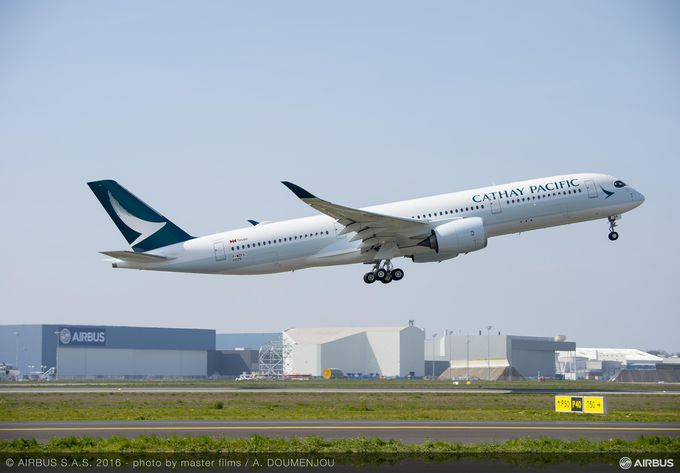
Figure 1. Most recent A350 delivery was to Cathay Pacific. source: Airbus.
The briefing was given against a backdrop of weak orders and deliveries for the first five months of the year. Both Bregier and Leahy said, “This is to be expected, it’s not sustainable that we have Book-to-Bill ratios (orders vs. deliveries) of over 1.5 or even close to two for many consecutive years. We have a backlog of 6,700 aircraft that customers expect us to deliver and they have little appetite to order new aircraft when they can earliest get them by 2021 at the earliest.
“We are now in a period of focus on deliveries and we can expect and be happy with a book to bill ratio of around one for the coming years. The extraordinary backlog also justifies our decision to increase production to 60 units per month for our A320 single aisle program.”
Here follows what was said for each of the programs.
New KC-46A delay means more charges probable
Subscription Required
Introduction
May 30, 2016, © Leeham Co.: It’s the classic maneuver to bury bad news: Boeing

Boeing KC-46A. Source: National Defense Magazine via Google images.
announced on Friday, the start of the three-day Memorial Day weekend that its KC-46A tanker will be delayed yet again. Only 16 days earlier, Boeing CEO Dennis Muilenburg said the tanker was on time under a schedule that had been revised previously.
That wasn’t all, according to the announcement. Even when the tankers are delivered, the wing pod refueling systems won’t be operational. (The Boeing statement is below the jump.)
If all this has a familiar ring, it should.
The previous version of the KC-46A, the KC-767 International Tanker, was delayed four years in part because of flutter issues with the pod refueling systems.
Only eight of these tankers were built: four for the Italians and four for the Japanese. Boeing took huge write-offs for these tankers.
Summary
- Will the latest delay be the last?
- Boeing is building tankers despite the need for rework and some internal design changes.
- Are we facing the prospect of a new set of “Terrible Teens”?
- Another write-off is probable-and it may not be the last.
- Will the full USAF tanker procurement yield a profit on the sale?