Leeham News and Analysis
There's more to real news than a news release.


Pontifications: Turbulence is not just something in the air

By Scott Hamilton
July 20, 2020, © Leeham News: The timing is coincidental. If you think the airline industry is in a wind shear now, don’t be fooled.
The industry has been in perpetual turbulence for 50 years.
 At least that’s the theme of an airline executive’s new book, Turbulence.
David Banmiller began his career as a ticket agent, when hand-writing the coupons at the airport as common practice.
He retired three years ago after a career that saw him in executive positions at AirCal, American Airlines and other carriers.
He became a bankruptcy reorganization specialist as well.
Careers
Banmiller weaved through American, TWA, AirCal, the second Pan Am, Aloha and Air Jamaica. He was CEO of AirCal when it was sold to American, where he became an executive under legendary CEO Bob Crandall. Banmiller went on to become CEO of Aloha, Pan Am and Air Jamaica. He took the first two through bankruptcy reorganization and restructured Air Jamaica outside of the courts. He also served as CEO of Sun Country Airlines.
Throughout his careers, Banmiller experienced many of the downturns of the airline industry: oil price wars, 9/11, the SARS pandemic and now, from his retirement, COVID-19.
An economic crisis on top of a medical one: Why airline traffic won’t fully recover until the mid-late 2020s
Open To All Readers
By Judson Rollins
Introduction
July 13, 2020, © Leeham News: As the world waits for the COVID-19 storm to abate, questions are growing over the duration of a demand downturn for airlines.
Many journalists and industry observers have been obsessively searching for “green shoots” indicating the beginning of a recovery, but much of this commentary misses the mark. For instance, much attention has been focused on capacity restoration in the US and China. However, little is known about the percentage of seats filled by Chinese carriers – and last week United Airlines told employees in an internal presentation that while US carrier capacity in July is back to 47% of 2019’s level, it believes industry traffic has only reached 28% and revenue just 19%.
Last month, investment research firm Bernstein published an analysis calling for narrowbody traffic to recover by 2023 and widebody traffic by 2025. This is consistent with most public forecasts from airlines, banks, and industry observers. The firm’s analysts said that single-aisle concentration in short-haul and domestic routes should see them returned to 2019 utilization sooner than twin-aisles due to reduced long-haul demand and lower demand in short-haul markets previously served by widebodies (e.g., in most of Asia).
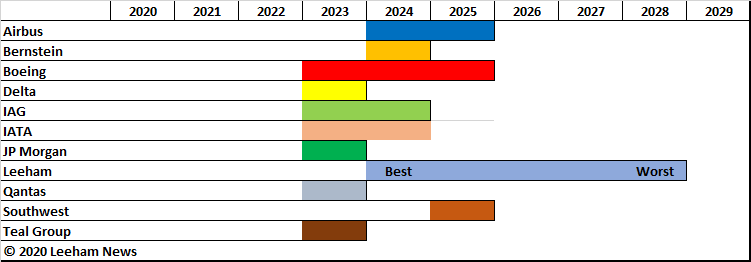
LNA believes that 2024 is the earliest possible date for a return to 2019 global passenger traffic – and it could conceivably take until 2028. Many obstacles lie between the present situation and a full recovery: deployment of a successful vaccine (or vaccines), rollback of border restrictions, passenger confidence in the medical safety of air travel, and most importantly, restored willingness to pay by business and leisure travelers. Specific countries or regions – especially those with local vaccine production – may recover sooner, but a global recovery to pre-COVID traffic levels requires all these to happen at a global scale.
To be clear, LNA’s definition of “herd immunity” is that of the global medical community: population-level resistance to virus transmission that occurs because a large majority have been vaccinated or previously infected. This differs from an increasingly popular usage of the term in reference to the passive infection-oriented virus management approach taken by Sweden and other countries.
Summary
- Widespread uncertainty means downturn likely to outstrip previous ones in duration, magnitude
- Vaccine development may be expedited; global distribution will take longer
- Herd immunity to COVID-19 is a prerequisite to confidence in travel safety, reopening of borders
- Open borders, restored economic activity are keys to any rebound in business travel
- Consumer travel requires confidence in personal income, availability of lower fares
Bjorn’s Corner: Do I get COVID in airline cabins? Part 10. Trans-Atlantic trip.
By Vincent Valery
July 10th, 2020, © Leeham News: In our Corner series about flying during the COVID-19 pandemic, we look at a trip undertaken last week by a member of the LNA team, Vincent Valery. Vincent, who flew from New York to visit family in France close to Geneva, writes this post.

On the flight over the Atlantic in Economy. Source: All photos LNA.
Looking ahead for 2020 and 2030 decades: Embraer
Subscription Required
Fourth in a series.
By Bjorn Fehrm
Introduction
July 8, 2020, © Leeham News: All airliner OEMs have a disastrous 2020, but for Embraer, the year has been even worse. After spending a year and over $200m to carve out the Commercial Aviation division to merge it into Boeing, the Joint Venture Agreement (JV) was stopped by Boeing at the last moment.
The Executive Jets and Defense side were not affected, but now Embraer was organized as two companies instead of one. The company must now re-merge the organizations to save costs in a COVID-19 environment where limiting cash outflow, and lowering costs are necessary for survival. At the same time, it’s arch-rival on the world market, Airbus A220 has gone from strength to strength through basket selling with the popular A320.
How does Embraer come back from the Boeing pass up and regroup in a regional market that is no longer a fight of equals? Embraer competes with Airbus that in 2019 was 11 times larger in airliner deliveries and 29 times in airliner revenue.
Only in the below 100 seat market is it saved from the giant, who doesn’t have a model in the segment. And it seems the below 100 seat competitor, Mitsubishi, might fold its entry.
Summary
- The botched JV with Boeing came at the worst possible moment for Embraer, just when the COVID-19 pandemic stopped airliner deliveries.
- The planned JV had held back sales and deliveries, waiting for the JV to complete.
- In addition, it cost Embraer $200m, pushing it into the red for 2019.
- Embraer must now find another fix to the Airbus problem while wrestling with a worldwide COVID crisis.
Read more
Pontifications: Why I won’t be flying any time soon
July 6, 2020, © Leeham News: I really, really want to return to traveling by air soon. But I don’t expect to fly until next year.
By Scott Hamilton
I’m not worried about being on the airplane. As LNA’s Bjorn Fehrm detailed over a series of Friday posts, the cabin purification technology scrubs the air every few minutes.
The problem is not the airplane.
It’s the people who fly.
Here’s why.
Pontifications: Deferrals, bankruptcies continue; order recovery far off

By Scott Hamilton
June 22, 2020, © Leeham News: Although more passengers are flowing through airports and airlines are adding back service, airplane order deferrals continue.
Airline bankruptcies do, too.
LEVEL’s short haul operation went into bankruptcy last week. LATAM Argentina ceased operations. Lufthansa said it may seek administration if shareholders don’t agree to the government bailout negotiated by the airline.
New orders dried up. And, so far, there is no telling when there might be some placed.
Boeing announced just a handful of new orders last month. Airbus didn’t announce any orders in May.
How much of International passenger flights can be paid by belly cargo? Part 2.
By Bjorn Fehrm
Subscription Required
Introduction
June 11, 2020, © Leeham News: As international passenger traffic slowly recovers, how much of the cost of flying passengers on the international routes can be paid by the freight under the floor?
We discussed the base parameters to answer this question in last week’s article. Now we calculate the revenues from passengers traffic and Cargo and compare them with the operational costs.
Summary:
- The high freight prices make it possible to resume international passenger flights without losses on routes where there is substantial freight demand.
- As belly freight capacity comes back to the market the freight prices will decline, but by then the passenger load factors should be on the way up.
France to invest 15 billion Euro in its aeronautical industry
By Bjorn Fehrm
June 10, 2020, ©. Leeham News: France presented a 15 billion Euro support plan for the French aeronautical industry yesterday, to help the industry overcome the effects of the COVID-19 pandemic.
The plan has three focus areas:
- safeguard the employment of the 300,000 employed in the French aero industry
- transform the supplier network to a more robust structure
- and perhaps most interesting, set the direction for the industries’ next aircraft projects

The French Finance Minister announces the plan. Source: France 24.
HOTR: LATAM files bankruptcy, latest COVID airline casualty; 1,100 aircraft involved
By the Leeham News Staff
May 26, 2020, © Leeham News: LATAM, the largest airline company in South America, filed for Chapter 11 bankruptcy today in New York.
LATAM operates more than 300 aircraft. This filing means more than 1,100 worldwide were operated by airlines seeking bankruptcy or administrative protections. The UK’s Flybe was already failing before COVID effectively shut down UK air travel.
Many others teeter on the edge, saved for the moment by government bailouts.
Below is LNA’s latest tally of aircraft.
Airbus 1Q2020, preparing for “the gravest crisis in our industry’s history”
April 29, 2020, © Leeham News: Airbus presented its results for the first quarter of 2020 today. In the accompanying news conference, Airbus CEO Guillaume Faury said, “we are facing the gravest crisis in our industry’s history,” and the company is implementing several measures to secure Airbus’ future.
World travel has disappeared, and new airliner deliveries will be down for years. Production of Airbus commercial aircraft is cut with one third, but this will be adapted as actual demand evolves, with the next adjustment expected in June.