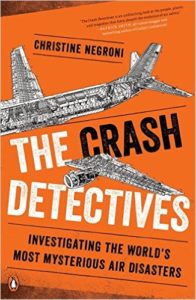
 July 5, 2016, © Leeham Co.: The Crash Detectives, by Christine Negroni, © 2016. Penguin Books. Available on Amazon.com.
As an avid follower of The Smithsonian Channel’s “Air Disaster” series and The Weather Channel’s “Why Planes Crash,” as well as knowing Christine Negroni, I was anxious to read her new book, The Crash Detectives. (Negroni is also the author of Deadly Departure, about TWA Flight 800.)
Negroni is no wanna-be aviation disaster geek. Her resume qualifies her to understand aviation accidents and speak and write with knowledge about them.
Negroni writes about dozens of aviation accidents and mysteries. Some of these are well known (the de Havilland Comet I accidents, for example). Some were miraculous outcomes (United Airlines 232, US Airways 1549, Qantas Airways 32). Some are ancient history (pre-World War II, including the disappearance of Amelia Earhart.)
Among the most interesting are the accidents in which hypoxia of the pilots are involved. These make fascinating reading. And it is hypoxia that is the leading cause of Negroni’s theory of one of commercial aviation’s most infamous mystery.
Read more

Boeing launches PFS 2.0
Update, 0815 PDT July 7: Boeing Corporate Headquarters responded to our questions. The transcript has been added to the article below.
Boeing wasn’t shy about who it targeted, or punished. Even supply-chain giant United Technologies was placed on Boeing’s no-fly list when it balked at the onerous demand.
Now Boeing is moving forward with PFS 2.0, a second round of demands.
Summary
Read more
21 Comments
Posted on July 7, 2016 by Scott Hamilton
air force tanker, Boeing, Leeham News and Comment, Pacific Northwest Aerospace Alliance, United Technologies
747-8, 787, Boeing, Dave Gitlin, Héroux-Devtek, Jim McNerney, KC-46A, Michel Merluzeau, Pacific Northwest Aerospace Alliance, Partnering for Success, PFS 1.0, PFS 2.0, PNAA, Richard Aboulafia, United Technologies Aerosystems, UTAS
IATA, Lufthansa cargo reports are discouraging
July 6, 2016, © Leeham Co.: Going into the Farnborough Air Show (#FIA16 on Twitter) next week, ominous signs continue to emerge about the health of the air cargo
Photo via Google images.
industry.
The International Air Transport Assn. (IATA) Wednesday said yields and traffic remain under pressure. Freight tonne kilometers fell 0.9% year-over-year, IATA reported.
“Yields remained pressured as freight capacity measured in available freight tonne kilometers (AFTKs) increased by 4.9% year-on-year,” IATA said. “reight demand decreased or flat lined in May across all regions with the exception of Europe and the Middle East. These regions recorded growth in air cargo volumes of 4.5% and 3.2%, respectively, in May, compared to the same period last year.”
Lufthansa Cargo saw yields in a “landside” drop, according to a Bloomberg report.
Read more
5 Comments
Posted on July 6, 2016 by Scott Hamilton
Airbus, Airlines, Boeing, Farnborough Air Show, IATA, Paris Air Show
747-8F, A330F, Airbus, Boeing, Farnborough Air Show, IATA, International Air Transport Assn., Lufthansa Cargo, Paris Air Show, Volga-Dnepr
Farnborough Preview #3: Analysts weigh in
Below are a few final previews from aerospace analysts, followed by other analyst reports for the last week. There will be no Weekly Analyst Synopsis next week because of the Show.
Highlights below:
Read more
10 Comments
Posted on July 6, 2016 by Scott Hamilton
Airbus, Boeing, Farnborough Air Show
737 MAX, 777X, Airbus, Boeing, Farnborough Air Show, Southwest Airlines, Spirit Aerosystems
Book Review: The Crash Detectives
As an avid follower of The Smithsonian Channel’s “Air Disaster” series and The Weather Channel’s “Why Planes Crash,” as well as knowing Christine Negroni, I was anxious to read her new book, The Crash Detectives. (Negroni is also the author of Deadly Departure, about TWA Flight 800.)
Negroni is no wanna-be aviation disaster geek. Her resume qualifies her to understand aviation accidents and speak and write with knowledge about them.
Negroni writes about dozens of aviation accidents and mysteries. Some of these are well known (the de Havilland Comet I accidents, for example). Some were miraculous outcomes (United Airlines 232, US Airways 1549, Qantas Airways 32). Some are ancient history (pre-World War II, including the disappearance of Amelia Earhart.)
Among the most interesting are the accidents in which hypoxia of the pilots are involved. These make fascinating reading. And it is hypoxia that is the leading cause of Negroni’s theory of one of commercial aviation’s most infamous mystery.
Read more
12 Comments
Posted on July 5, 2016 by Scott Hamilton
Airbus, Boeing, Malaysian Airlines, MH370
777, 787, Airbus, Boeing, Christine Negroni, Comet, Crash Detectives, de Havilland, Malaysia Airlines, MH370, Qantas Airways, United Airlines
Pontifications: Boeing is back
By Scott Hamilton
July 4, 2016, © Leeham Co.: It’s looking like all the pain and agony of the 787 development is behind Boeing. (Except for the deferred production costs, of course.)
Boeing is back into airplane development mode.
To be sure, only one of these is a new airplane. The others are derivatives. But at least Boeing seems to be on the move after slowing the train (to mix the metaphors) considerably following the 787 debacle.
Read more
98 Comments
Posted on July 4, 2016 by Scott Hamilton
Airbus, Boeing, Farnborough Air Show, GE Aviation, MOM, Pontifications
737-10, 737-7, 737-7.5, 737-9, 757, 767, 777-10, 777-9, 787, Airbus, Aviation Week, Bloomberg News, Boeing, Farnborough Air Show, Jon Ostrower, New Mid-market Aircraft, Wall Street Journal
Farnborough Air Show preview: expectations and possible surprises
Introduction
July 4, 2016, © Leeham Co: The Farnborough Air Show begins next Monday and predictably, focus will be on orders.
With new airplanes from Airbus and Boeing past their development stages, conventional wisdom says there won’t be much new in this arena.
Don’t be so sure.
Bombardier is now on an upward trajectory, but don’t look for a big splash at #FIA16 (for those looking for this year’s Twitter handle). Embraer will have its E190-E2 at the show.
It’s Boeing’s 100th Anniversary and the company is rolling out the history for the show.
Summary
Read more
1 Comment
Posted on July 4, 2016 by Scott Hamilton
Airbus, Boeing, Bombardier, CFM, Comac, Embraer, Farnborough Air Show, Irkut, Mitsubishi, Pratt & Whitney, Premium, Rolls-Royce
Airbus, Boeing, Bombardier, Comac, Embraer, Farnborough Air Show, Irkut, Mitsubishi
Southwest’s MAX deferral
Subscription RequiredIntroduction
Southwest Airlines deferred 67 Boeing 737 MAX deliveries and some viewed this as a negative for the program. Photo via Google images.
June 29, 2016, © Leeham Co.: News last week that Southwest Airlines deferred 67 Boeing 737 MAX deliveries three year caused some to conclude that this is a harbinger of bad news for Boeing and the MAX program.
LNC disagrees with this conclusion.
Summary
Read more
Leave a Comment
Posted on June 30, 2016 by Scott Hamilton
Airlines, Boeing
737 Classic, 737 MAX, 737NG, Boeing, Credit Suisse, Goldman Sachs, Southwest Airlines
Analysts opine on Airbus, Boeing, Iran and Brexit
Click on image to enlarge.
June 24, 2016: Brexit continues to creep into US analyst reports for the potential impact of companies doing business in the United Kingdom.
But there are other issues as well. Highlights this week:
Read more
32 Comments
Posted on June 29, 2016 by Scott Hamilton
Airbus, Airlines, B/E Aerospace, Boeing
Airbus, airlines, BE Aerospace, Boeing, Buckingham Research, Credit Suisse, Goldman Sachs, Iran Air, JP Morgan, Morgan Stanley, Southwest Airlines, Spirit Aerosystem
Brexit special: analyst reaction
Source unknown. Via Twitter.
June 27, 2016: Aerospace and airline analysts are reacting to Thursday’s vote in Britain to leave the European Union. Below is a synopsis of some of the analyst notes we receive.
Credit Suisse
We are forwarding the analysis our European Transports team put out this morning on Brexit and have a few observations as it relates to US Airlines.
Read more
70 Comments
Posted on June 27, 2016 by Scott Hamilton
Airbus, Airlines, Boeing, IATA
Airbus, Boeing, Brexit, CanaccordGenuity, Cowen & Co, Credit Suisse, IATA
Pontifications: Time to calm down from last week’s news cycle
By Scott Hamilton
June 27, 2016, © Leeham Co.: Last week turned out to be one of the busiest in aviation in quite some time.
As you can see from my sarcasm, I disagree with each of these. Here’s why.
Read more
113 Comments
Posted on June 27, 2016 by Scott Hamilton
Airbus, Boeing, Farnborough Air Show, Paris Air Show, Pontifications
737 MAX, Airbus, Boeing, Brexit, Farnborough Air Show, Iran Air, Paris Air Show, Southwest Airlines, Volga-Dnepr
Email Subscription
Associations
Aviation News-Commercial
Commentaries
Companies-Commercial
Companies-Defense
Engines
Resources
YouTube
Archives