
Leeham News and Analysis
There's more to real news than a news release.


Pontifications: Hawaiian Air ponders A380
By Scott Hamilton
Oct. 31, 2016, © Leeham Co.: Hawaiian Airlines continues to ponder the possibility of acquiring one or two Airbus A380s, its CEO said on the third quarter earnings call—something that raises eyebrows and a lot of questions with industry officials.
Mark Dunkerley, responding to a question on the call, said there are two or three routes that could support the giant A380.
Bjorn’s Corner: Turbofan engine challenges, Part 1

By Bjorn Fehrm
October 28, 2016, ©. Leeham Co: Before we go into the details on the innards of airliner turbofans, we will look at some basics. We do that so that everyone is on the same page.
A turbofan engine generates thrust by pumping air out the back of the engine. This air has a higher speed than surrounding air. Air is actually quite heavy: it weighs 1.2kg per m3 at sea level. By kicking out air at an overspeed in relation to the aircraft, thrust is generated.
In a modern turbofan, the kicking gets done by the fan to 80-90% in the modern By Pass Ratio (BPR) 8-10 engines. A single aisle engine generating 10 tonnes of thrust throws around 350kg of air per second backwards at close to sound speed in a take-off situation. To drive the fan to do that, there is a lot of shaft horse-power needed, around 30,000hp.

Figure 1. Work cycle for jet engine/turbofan core compared to car engine. Source: Rolls-Royce book “The Jet Engine.”
These hp are generated by the core. The thermodynamic cycle to generate all these hp in a jet engine or turbofan core (we call both a gas turbine) is like the one in a normal car engine, Figure 1, with the difference that it is a continuous cycle.
We will now go through this cycle in steps. Read more
Counting down to 737-10, NMA
Subscription Required
Introduction
Oct. 27, 2016, © Leeham Co.: Boeing faces decisions in the near term on whether to proceed with the 737-10 stretch of the MAX 9 and the New Mid-range Airplane (NMA) to serve the Middle of the Market sector (MOM).
The 737-10 is intended to compete with the Airbus A321neo, stemming significant bleed at the top end of the 737 line.
The NMA will address the top end of the MOM sector, carry more passengers and have more range than the Boeing 757 and A321neoLR.
Boeing still has critical issues facing it before proceeding with either airplane.
Summary
- A simple stretch to create the 737-10 has technical and operational issues.
- The proposed date for entry-into-service still gives Airbus an insurmountable lead.
- The market for the 737-10 remains limited. Is the return on investment there?
- The market for the NMA is identified in the abstract—but price will be a key driver.
Visit to Bombardier for airBaltic CS300 roll-out
By Bjorn Fehrm
October 27, 2016, ©. Leeham Co: This week we have been at Bombardier (BBD) Mirabel Airport outside Montreal to observe the roll out of the airBaltic CS300 CSeries model and to later test fly the aircraft at BBD’s Wichita facility.
The preparation for the test flight and the flying experience will be described in subsequent articles.
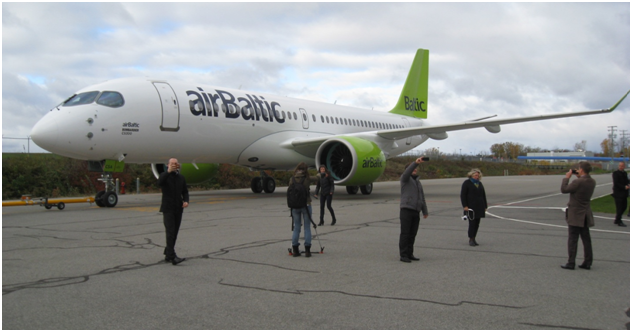
Figure 1. airBaltic’s first CS300 rolled out for local media to see. Source: Leeham Co.
airBaltic will take delivery of the first CS300 by the end of November. This event was for Baltic media to see the aircraft and its final livery for the first time. It was fresh from the paint shop. The group also was able to see the CSeries Final Assembly Line (FAL) and to ask questions to airBaltic CEO Martin Gauss.
Airbus results depressed from continuing delivery delays
 Oct. 26, 2016: Airbus Group reported that its nine months financial results continue to be depressed by delivery delays in the A320neo and A350-900 programs.
The Group reported revenues of €43bn for the period and charges that lowered profits.
Net cash fell by nearly €5bn from the same period last year. Earnings at the Commercial unit fell 59% YOY.
The press release with detailed results may be found here.
Pontifications: Rockwell buying B/E Aerospace: getting out while the getting is good?
By Scott Hamilton
Oct. 24, 2016, © Leeham Co.: An announcement Sunday by supplier Rockwell Collins (NYSE:COL) that it will acquire B/E Aerospace (NYSE: BEAV) for $6.5bn caught analysts by surprise. The price tag rises to $8.3bn when assumption of BEAV’s debt is included.
The surprise is not so much BEAV is selling itself. A few years ago, BEAV sold of one of its division and analysts since then believed an exit strategy was underway for the principal owners of the company.
The surprise is that the buyer is Rockwell, a supplier that has little in common with BEAV. A slide from Rockwell’s own investor presentation Sunday illustrates the point.
Rockwell will have an investors’ call Monday at 0830 EDT to further explain the merger.
Seventeen new, derivative aircraft to see EIS through 2020
Subscription Required
Introduction

Delivery of the first Bombardier CS300, to AirBaltic, next week kicks off entry-into-service for 17 airplanes through 2020. Bombardier photo.
Oct. 20, 2016, © Leeham Co.: The past decade was a hive of activity as the Big Four OEMs launched new airplane programs and put the aircraft into service.
Airbus launched the A320neo, A330neo and A350 families. The A330neo is under production; the other two entered service early this year.
Boeing launched the 787 in late 2003 (outside the decade mark), rolled it out in 2007 and entered service with it in 2013. The 737 MAX was launched in 2011 and is in flight testing. The 777X was launched in 2013; components are in production.
Bombardier launched the CSeries in 2008; it entered service this year, after three years of delays.
Embraer launched the E-Jet E2 om 2013. Flight testing began this year.
New Entrants
These were supplemented by new entrants into commercial aviation: COMAC with its C919; Irkut with the MC-21; and Mitsubishi with the MRJ90. Of these, only the MRJ90 is flying. After more than two years of delays and several false starts, flight testing began in earnest this week at Moses Lake (WA) with FTA-1 (Flight Test Aircraft 1).
Development and new program launches have slowed, but the next decade is hardly going to be idle.
Summary
- Seventeen new aircraft or derivatives are scheduled to enter service through 2020.
- Five potential derivatives might see EIS through the same period.
- Three to five new or potential derivative aircraft might see EIS 2021-2025.