
Leeham News and Analysis
There's more to real news than a news release.


Paris Air Show, Day 4: Closing orders, commitments
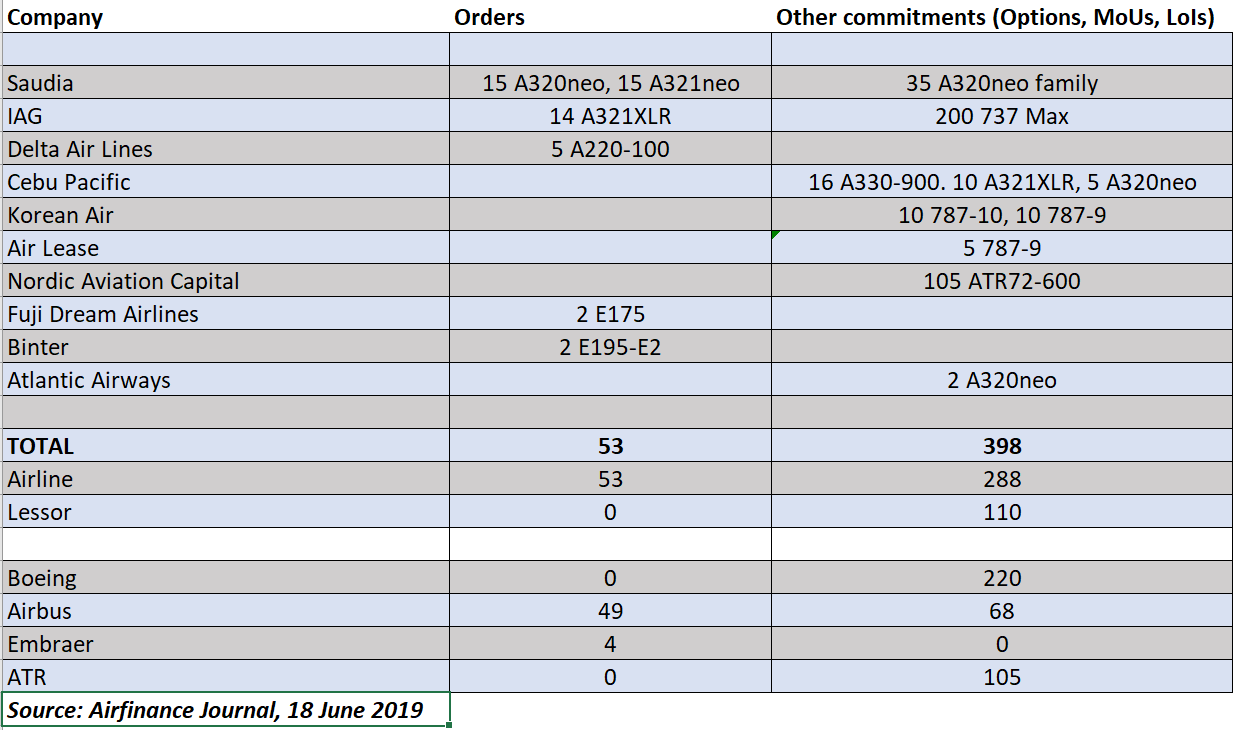
June 20, 2019, © Airfinance Journal: By day four of the Paris Air Show, most of the OEMs had already wrapped up their deal-making, but there was still time for Airbus to  tempt another two airlines and another lessor towards the A321XLR and the A220-300 products.
Airbus and CFM are the manufacturers that will leave Paris the happiest, although ATR was keen to make its case, citing 75 “new orders” at the show. However, in line with the odd phrasing employed by most marketing departments this week, it was difficult to discern what those “orders” meant. ATR said they included “35 firm orders from NAC disclosed on June 18”, but its press release about that deal described only a “letter of intent for 35 firm ATR -600s, with options for a further 35 and purchase rights for another 35.”
Paris Air Show, Day 3: Orders and Commitments
June 19, 2019, Paris: Here are the orders and commitments from Day 3 of the Paris Air Show, via Airfinance Journal.
Paris Air Show Day 3: Eyes focus on Boeing for more MAX commitments
June 18, 2019, © Leeham News: As the Paris Air Show prepares for Day 3 (June 19, Paris time), eyes will be on Boeing to see whether another commitment for the 737 MAX will be forthcoming.
Headlines the first day were split between Boeing’s early morning briefing in which executives apologized for the fatalities on the Lion Air and Ethiopian crashes, sympathies to their families and disruptions to the airlines for the groundings and the Airbus launch of the A321XLR.
Tuesday’s headlines belonged to Airbus until 4:30pm when International Airlines Group, the parent of British Airways, Iberia, Aer Lingus, Vueling and LEVEL, announced a commitment for 200 MAX 8s and MAX 10s.
If any such order was to come at the air show, observers expected it to be from Ryanair, whose CEO Michael O’Leary already had publicly endorsed the MAX and said he could order more.
Paris Air Show, Day 2: Orders and commitments
June 18, 2019, © Airfinance Journal: Boeing received a much-needed vote of confidence in its grounded 737 Max aircraft with a commitment for 200 of the type from IAG.
Nonetheless, the US manufacturer failed to register a firm order from the second day in a row.
Airbus, in contrast, continued to build momentum for its new A321XLR with orders and commitments from IAG and Cebu Pacific.
CFM also had a good day, registering big orders from lessors and AirAsia for its LEAP engine.
Paris Air Show, Day One: Mitsubishi makes case for “SpaceJet” market opportunity
By Judson Rollins
June 17, 2019, © Leeham News, Paris: Senior executives from Mitsubishi Aircraft Company (MITAC) and parent Mitsubishi Heavy Industries (MHI) described the long journey to the revamped “SpaceJet” M90 and M100 aircraft. They also commented on what market role the SpaceJet could potentially fulfil, as well as potential incremental improvements to the aircraft.
MHI chairman Shunichi Miyanaga said that market conditions and competitive landscape have changed in the company’s favor as the need for regional jet replacement has grown and competition has dwindled down to just a single player, Embraer.
Paris Air Show Orders, Day 1
June 17, 2019, (c) Leeham News: Here are the orders and commitments for Day 1 of the Paris Air Show, courtesy of Airfinance Journal.
Looking at MAX beyond the grounding
June 17, 2019, © Leeham News, Paris: As the international aerospace community and media gathers here this week for the Paris Air Show, the Boeing 737 MAX is the elephant in the room.
The focus obviously is on when the MAX will return to service worldwide.
A few people are already looking beyond this, to how quickly Boeing will ramp production back up and how quickly the backlog of completed airplanes will be delivered to airlines and lessors.
The grounding appears that it will go on much longer than expected.
E175-E2 prototype in production, first flight by year end
May 28, 2019, © Leeham News: The first E175-E2 prototype is now in production at the Embraer plant here at Sao Jose dos Campos, Brazil, despite having no firm orders and only a single conditional order for 100 aircraft from a US airline that so far can’t use the airplane.
The pilot union contracts contain a clause that prevent the only customer for the aircraft in  the world from using it because the take-off weight exceeds the 86,000 lbs specified in the contract.
Embraer designed the airplane with the hope the so-called Scope Clause would be relaxed in contract negotiations this year and next by pilots for American, Delta, United and Alaska airlines. It’s become clear that relief is unlikely.
Mitsubishi sets stage for announcement at Paris
Subscription Required
Introduction
By Bryan Corliss
May 10, 2019, © Leeham News: Senior officials of Mitsubishi Aircraft Corp. said they’ll announce a new concept to replace their proposed MRJ70 at next month’s Paris Air Show. But they’re keeping details to themselves until then.
“We’ve got a couple rabbits in our hat,” said Alex Bellamy, the chief development officer for the MRJ program. “We’d like to keep them in our hat for now. But rabbits have a habit of bouncing.”
Bellamy spoke with a handful of industry reporters Friday at a roundtable following the formal grand opening of Mitsubishi Aircraft Corp America’s new office in Renton (WA). The event – which included the ceremonial opening of sake barrels with hammers–attracted senior executives from MITAC’s headquarters in Nagoya, Japan, and local business and government leaders.
 Mitsubishi is flight-testing the 92-seat MRJ90 in the skies above Moses Lake (WA). But in Nagoya, engineers are working on a clean-sheet design for a 76-seat, three-class regional jet.
It’s what the market is calling for, Bellamy said, and right now, there’s a declining number of competitors willing to provide it.
Summary
- One competitor is going, the other doesn’t have a modern, Scope-compliant aircraft.
- 50-years opportunity.
- Combining comfort and new-technology economy
Pontifications: Rebuilding the MAX and Boeing brands
By Scott Hamilton
May 6, 2019, © Leeham News: Boeing has a big job ahead of it to restore faith in the 737 MAX with flight crews and the flying public.
Recertification is still weeks or perhaps months away. The return to service may be anywhere from July to August or even longer, depending on how global regulators proceed with review and approval of the revised MCAS software and pilot training.
Pilots at airlines seem split whether a “simple” computer training protocol is sufficient or whether a flight simulator training is required.
Let’s set all this aside on the safe assumption this will work itself out, whether sooner or later.
So, the question then becomes: how does Boeing repair the MAX brand—and its own.