
Leeham News and Analysis
There's more to real news than a news release.


Pontifications: Twelve new designs in 10 years spurred orders
By Scott Hamilton
Aug. 8, 2016, © Leeham Co.: The book:bill for Airbus and Boeing this year will be hard-pressed to reach one. Airbus has a better shot, given lower production rates. But the recent years of record-setting orders are over for now.
Unlike some, this doesn’t represent a bursting bubble to LNC. Rather, it’s a natural progression of the cycles that are historically seen.
It’s necessary to put some context into the recent years of these unprecedented number of orders.
Bjorn’s corner: Farnborough week

By Bjorn Fehrm
July 15, 2016, ©. Leeham Co, Farnborough Air Show: We have been at Farnborough Air Show this week, the highlight of the year for an aircraft geek like me. This year there were several interesting aircraft that visited the show for the first time.
Embraer brought over the brand new first prototype of the E-jet 190-E2 and the prototype of their military transporter, the KC-390. Bombardier had their first customer/production CS100 from Swiss to visit the show in addition to their Flight Test Vehicle (FTV) no 5. And Lockheed Martin had the F35B, the vertical landing version, come and hover over the airfield the days that were reasonably rain free in the afternoon.
One thing is clear with the new generation of Single Aisle aircraft: their high bypass engines dominate the visual appearance. Figure 1 shows the 73 inch version of the Pratt & Whitney GTF on the E190-E2 prototype. Huge diameter engine on a not so huge diameter aircraft.
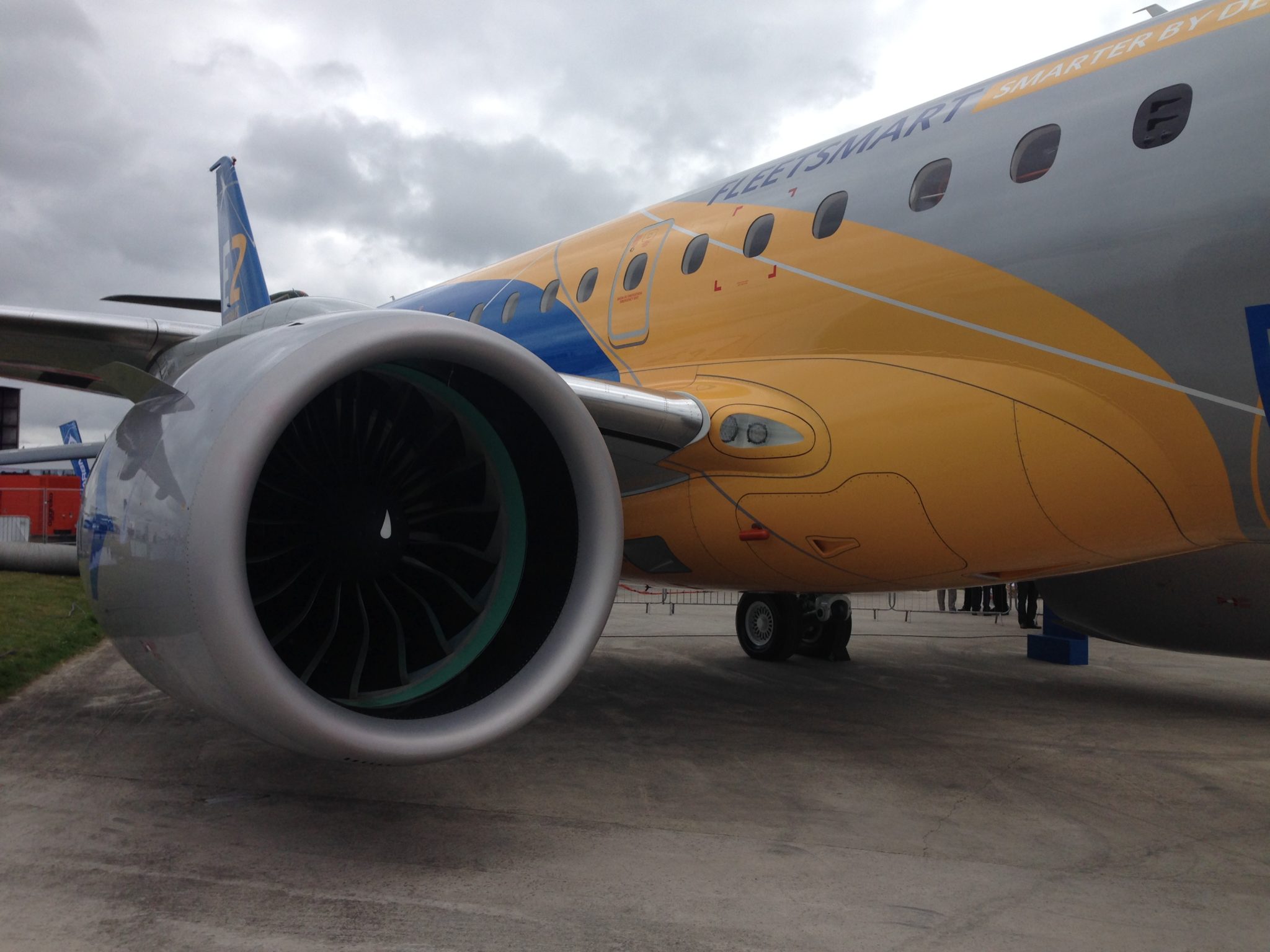
Figure 1. The prototype E190-E2 with its Pratt & Whitney GTF engine on the Farnborough apron. LNC photo.
Farnborough Air Show preview: expectations and possible surprises
 Subscription Required
Introduction
July 4, 2016, © Leeham Co: The Farnborough Air Show begins next Monday and predictably, focus will be on orders.
With new airplanes from Airbus and Boeing past their development stages, conventional wisdom says there won’t be much new in this arena.
Don’t be so sure.
Bombardier is now on an upward trajectory, but don’t look for a big splash at #FIA16 (for those looking for this year’s Twitter handle). Embraer will have its E190-E2 at the show.
It’s Boeing’s 100th Anniversary and the company is rolling out the history for the show.
Summary
- No new products from Airbus.
- Boeing may have a surprise.
- Low number of orders anticipated.
UTC media day 1: UTAS, twice the size of any other aerospace systems company
Note: United Technologies Corp (UTC) is holding its annual Media Days today and tomorrow. We’re providing reporting from the event. This is the first time in our long participation that UTC Aerospace Systems is presenting. UTAS is a major supplier and service provider to all the airframe OEMs.
June 6, 2016: UTC Aerospace Systems is just four years old, following mergers with

Dave Gitlin, CEO of UTC Aerospace Systems (UTAS).
Hamilton Sundstrand and Goodrich–the largest in aerospace history, says Dave Gitlin, president of UTC Aerospace Systems.
UTAS provides electrical power and bleed air systems, engine, starters, power systems, all the circulating fans on the Boeing 787, monitoring systems and much more. Evacuation slides, the Ram Air Turbines, landing gear, flaps and slat control systems, brakes and thrust reversers.
Can Bombardier extend CS300 to a CS500?
By Bjorn Fehrm
Subscription required
Introduction
April 14, 2016, ©. Leeham Co: Bombardier is working hard to get additional mainline airline customers for its C Series project. The latest discussion is whether Delta Air Lines would replace its fleet of Boeing MD-88s with the C Series.
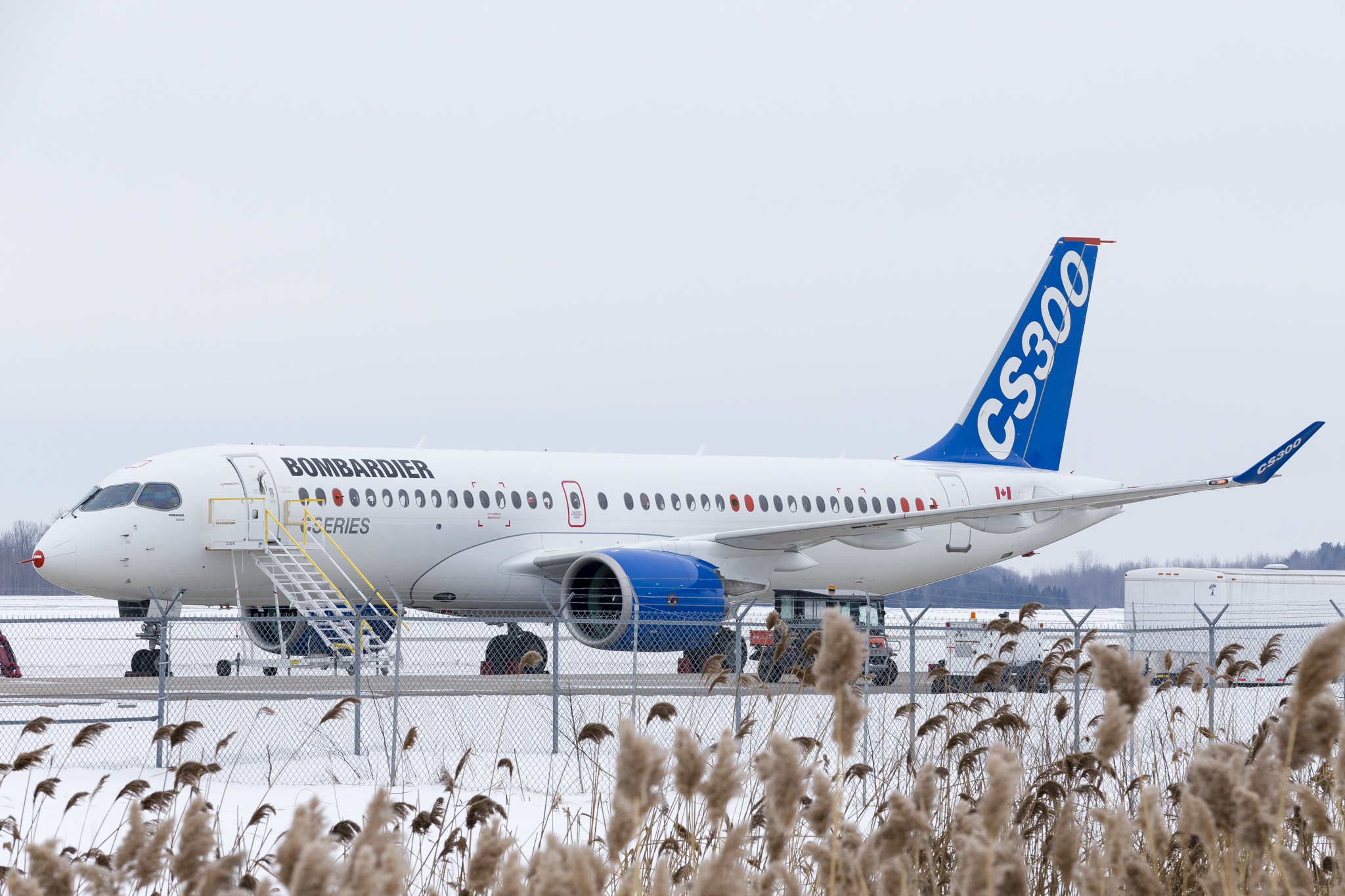
Figure 1. C Series largest model, CS300. Source: Bombardier.
In this context, it’s also discussed if the largest model, the CS300, Figure 1, is large enough for Delta. This aircraft seats 135 passengers in a two class configuration and up to 160 passengers in an all economy high density version.
The question is whether this is sufficient for Delta and other mainline customers, or if a still larger version is needed in the program, the oft-discussed CS500. We decided to use our proprietary aircraft model to see if a CS500 would be straight forward for Bombardier to develop, should Delta or any other customer ask for a three model C Series program.
Summary
- The C Series aircraft program was developed with the CS300 as the main model. The wing, engine and landing gear were dimensioned with the CS300 in mind.
- The CS100 is a shrink of the CS300, and not vice versa (the CS300 a stretch of the CS100).
- A tentative CS500 stretch if therefore a first stretch of the program’s main model and not a double stretch of a CS100.
- This is evident when one starts to analyze how a CS500 would be designed. There are rather modest changes that need to be done to create an extended model that seat up to 180 passengers.
ISTAT Day 1: Engine updates for CFM, GE, RR and PW
Feb. 29, 2016, (c) Leeham Co.: The LEAP engine, for the Boeing 737 MAX, Airbus  A320neo and COMAC C919 is the fastest-selling engine in history, says Jean-Paul Ebanga, the president of CFM International. More than 10,000 have been sold.
- We’re at the 2016 ISTAT AGM in Phoenix and will be reporting today and tomorrow on presentations and news from the sidelines.
“It’s on-time and on-spec,” Ebanga said. It’s either been on the date set four years ago or ahead of schedule. The engines delivered to Airbus for the A320neo are on spec, he said. It’s been certified for the neo and will be certified soon for the MAX, with 90% of the information submitted.
Irkut MC-21, first analysis
By Bjorn Fehrm
Subscription required.
Introduction
Feb. 08, 2016, © Leeham Co: We recently covered China’s COMAC C919 and now the time has come to the other new narrow body aircraft from the old Communist bloc, the Russian MC-21.
The aircraft is called Irkut MC-21. Not many have heard of Irkut, so the first reaction is that this aircraft is made by a new Russian aircraft firm. The change is that United Aircraft (the Russian aircraft industry holding company) this time called the aircraft after its manufacturing company and not the design bureau, Yakovlev, that Irkut acquired in 2004. There are discussions to change back to the project’s original name Yakovlev 242 once certification is done.
When we looked at the first civil airliner that the Russian federation designed after the fall of Soviet Union, the Sukhoi Superjet 100, we found a well designed aircraft equipped with Western system. The MC-21 follows the same lines, but has more Russian technological development. It is therefore well worth a look.
Summary:
- The MC-21 has its own profile. It is not a copy of a Western aircraft. It has a wider cabin than the A320, a wing which allows a higher cruise speed and a higher capacity in its base variant, the MC-21-300.
- To make a meaningful comparison between the MC-21 and established aircraft, we have chosen to compare the MC-21-200 with the Airbus A320neo, as the MC-21-300 is larger than the A320neo but smaller than an A321neo. The MC-21-200 is closer in size to an A320neo. Read more
Bjorn’s Corner: Exciting 2016
By Bjorn Fehrm
29 January 2016, ©. Leeham Co: In the corner of two weeks ago we did a retrospective of 2015. Time for looking ahead. The year of 2016 will be quite interesting. We had entry into service of the first re-engine single aisle aircraft this week, the Airbus A320neo, the same week as we expect first flight from its main competitor, Boeing’s 737 MAX 8. We will also see first flight of the Embraer E190E2 and A350-1000 before the year is over.
The Mitsubishi MRJ shall go test flying in earnest and Bombardier’s CSeries 100 and 300 shall enter service. On top of that, the COMAC 919 will probably start ground roll tests this year and we should see roll out of Irkut’s MC-21. I would say 2016 is a busy year for civil aviation.
In the 2015 corner we talked a lot about engine technology as a key driver to further efficiency of air transportation. Now will dissect the airframe technology that all these new projects will bring us. Read more
Pontifications: Shifting focus to Embraer

By Scott Hamilton
Jan. 25, 2016, © Leeham Co. Embraer announced last week it had cut metal on its first E195 E2, more than a month before the roll-out of the first E190 E2, scheduled for Feb. 25, at is Sao Jose, Brazil, plant.
The aggressive manufacturer of small(er) passenger jets is moving forward full speed toward its next generation of aircraft even as Airbus, Mitsubishi, COMAC and Irkut encounter one delay after another.
Bjorn’s Corner: What did we learn in 2015?
By Bjorn Fehrm
08 January 2016, ©. Leeham Co: It’s the first Corner for the year and a look at 2015 as a year of technology advancements is due. 2015 will be remembered as the year when three clean sheet airliners passed important milestones. This will not happen for many years to come, so it will be worth to look at what they brought to world of aviation.
I’m thinking of Bombardier’s (BBD) CSeries getting certification for its first variant; the Mitsubishi MRJ doing its first flight’ and COMAC’s C919 being rolled out. Going forward, we will only have derivatives progressing through such milestones for years except for the roll-out of United Aircraft’s MS-21 single aisle airliner in 2016.
The Airbus A320neo was certified in 2015 and Boeing’s 737 MAX rolled out, but these are derivatives of in-service aircraft.
Embraer’s E-Jet E2 will roll out in February but this is a further development of today’s E-jet and Airbus A350-1000 is a variant of the in-service A350-900.
It will be a long time before we see so much new in a year, so it can be instructive to look at to what extent did these new aircraft bring the state of the art of airliners forward.