
Leeham News and Analysis
There's more to real news than a news release.



Pontifications: A good week for Boeing wide-bodies

By Scott Hamilton
Oct. 17, 2016, © Leeham Co.: Boeing had a very good week for wide-body orders last week. It recorded 42 orders for the 787 and 10 for the 777-300ER.
Thirty of the former and all of the latter came from Qatar Airways. There were 12 787 orders from “Unidentified,” which in this case was from China Southern Airlines. These were announced Wednesday but too late to show up on the weekly orders update posted Thursday.
787 Book:Bill
For the year, Boeing has 61 net orders for the 787, a healthy increase since the end of June, when the book-to-bill was a paltry 0.25 YTD. Even at 61, this is still a book:bill of just 0.42 for the 787, which has not had a book:bill of more than one since 2013. This means Boeing continues to burn off the backlog faster than it is booking new orders.

But it’s welcome news nevertheless in a year when there has been a dearth of wide-body orders.
Read more
“Scope clauses stop aircraft development”
By Bjorn Fehrm
Subscription required.
Introduction
October 16, 2016, ©. Leeham Co: “Scope clauses stop aircraft development.”
The words are those of Rodrigo de Souza, Marketing manager of Embraer Commercial Aircraft when we spoke at the sidelines of the recent ISTAT conference in Barcelona.
De Souza made the comment when we discussed how the new E-Jet E175-E2 would fit with US scope clauses. It doesn’t.
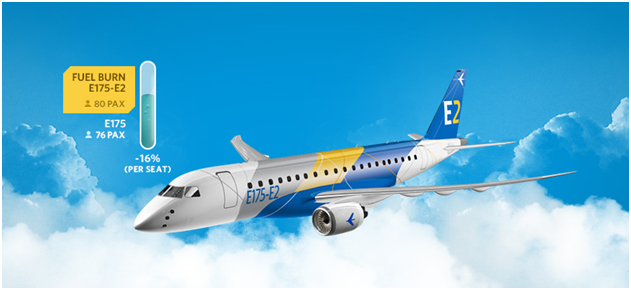
Figure 1. Embraer’s E175-E2, which gives an 11% improvement in fuel burn (the additional 5% is from 76 seats going to 80). Source: Embraer.
The problem is the limit on Maximum Take-Off Weight (MTOW).
“I can understand the other restrictions of a scope clause but not the Max Take-Off Weight restriction,” de Souza said. “It doesn’t make any sense; it just stops new and more efficient aircraft getting into the market. What relevance does it have in protecting mainline pilots from the regional operators taking over routes?”
Summary:
- The MTOW part of scope clauses hits all regional manufacturers.
- Embraer is not the worst hit; their present E175 is compliant and selling well.
- Mitsubishi is worse off. Its entire backlog of 240 MRJ90 is non-compliant. And some of its major customers fly for airlines with scope clauses.
- What is the solution? Why doesn’t scope clauses adapt to modern times?
Peeking into Boeing’s future airplanes
Oct. 18, 2016, © Leeham Co.: It was a rare look into potential future airplanes and passenger experience by Boeing, which is known for keeping these topics close to

Mike Sinnett, VP Product Development for Boeing. Taking 787 technologies and enhancing them for future airplanes. Photo via Google images.
its chest.
Mike Sinnett, VP of Product Development for Boeing Commercial Airplanes, last week gave an audience of nearly 250 people attending the annual Governor’s Conference organized by the Aerospace Futures Alliance, a look at some of the concepts Boeing is studying. Some may evolve into actual products and some may not, he said.
Bjorn’s Corner; The Engine Research Institutes

By Bjorn Fehrm
October 14, 2016, ©. Leeham Co: In our Corners on East bloc aeronautical industries, we will now look at the role of the Research Institutes in Russian and Chinese civil aircraft engine development.
The Russian engine industry is organized similarly to the aircraft industry. It has a powerful research organization which has a much larger role than research organizations in the West.
A large part of fundamental design work and testing is done at the research institute and not at the design bureau level, Figure 1.
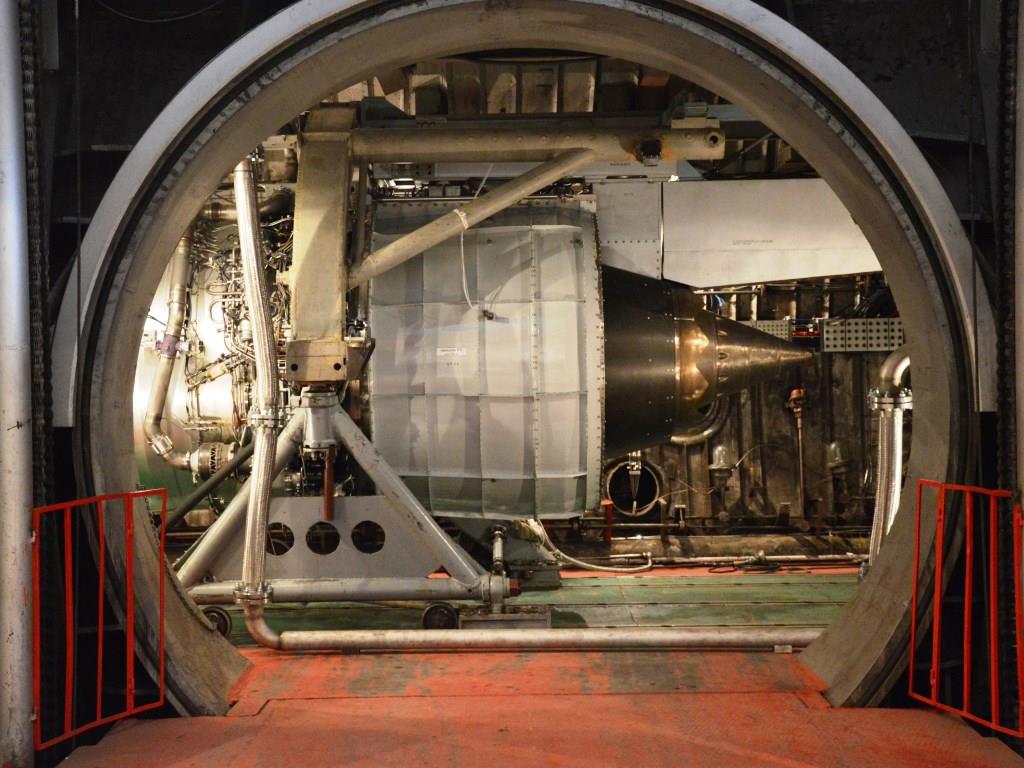
Figure 1. PD-14 engine altitude testing at the Central Institute of Aviation Motor Development (CIAM) in Moscow. Source: CIAM.
The Chinese organization of the engine industry is similar, the difference being that the research organizations are organized within the giant AVIC (Aviation Industry Corporation of China) grouping, rather than reporting to the state via a research organization path. Read more
The evolving European legacy carrier
By Bjorn Fehrm
October 13, 2016, ©. Leeham Co, Nice: Scandinavian Airlines (SAS) has fought its way back from a near-death experience in 2012, readjusting to the growing low cost carrier environment in Europe.
After nearly being bought by Lufthansa in 2008 the airline has had to slug it out themselves, gradually fighting its way back to sustained profitability.
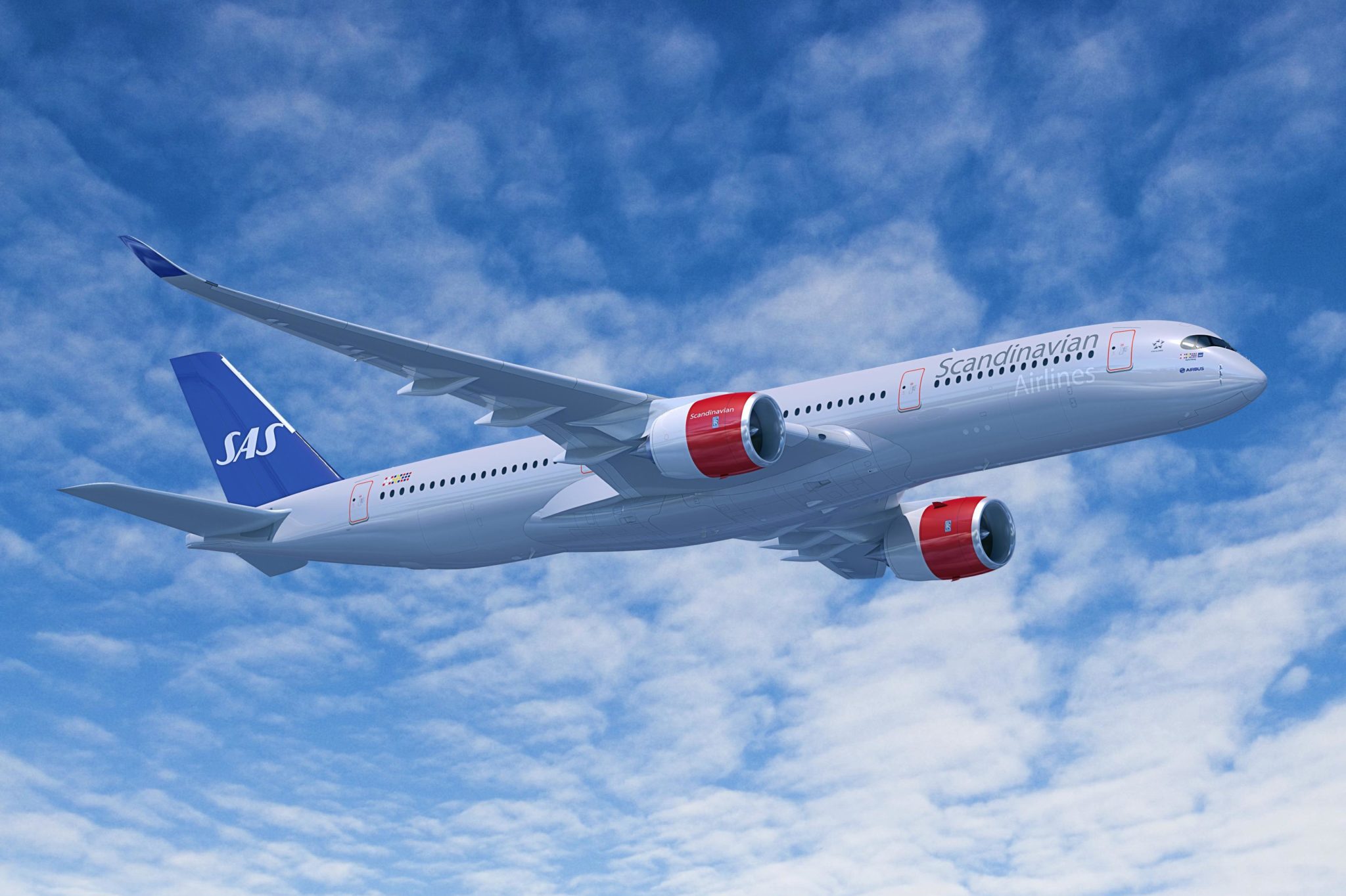
Figure 1. SAS will receive 6 Airbus A350 from 2019 to complement the A330. Source: Airbus.
Things are now looking up and the development and future of SAS is a good example of the problematic past and future of European legacy carriers.
Engine industry clamoring for road back
By Bjorn Fehrm
Subscription required.
Introduction
October 13, 2016, ©. Leeham Co: The airline engine industry is like a ticking bomb. Over the years, a business practice of selling the engines under manufacturing cost and planning to recover costs and make a profit on the aftermarket developed. This goes back decades.
The practice was fostered by fierce competition over the engine contracts for aircraft which offered alternative engines. The losses of the engine sales could be made up later by selling spare parts and services at high margins.

Figure 1. Trent 7000 from Rolls-Royce. Source: Rolls-Royce.
These “jam tomorrow” practices have several implications. The engine industry is now confronted with these and wonder how it could put itself in such a bind. How to handle these and what is the way back?
Summary:
- High competition in engine sales forced ultra high discounts for the up-front engine sale.
- Aftermarket schemes was created that should recover profits over spare parts and services.
- But these maintenance practices create all sorts of problems in the used engine market.
- The engine industry now wants to return to more normal business practices. But how do they find the way back?
Airbus, Boeing agree on NMA–for now

One concept of the middle of the market airplane.
Oct. 12, 2016, © Leeham Co.: It’s rare when Airbus and Boeing agree on product strategy, but officials of the two companies seemed in almost perfect alignment in separate interviews by LNC last week.
Barry Eccleston, president of Airbus Americas, and Mike Sinnett, VP of Product Strategy for Boeing, each said there is no consensus yet among customers for the Middle of the Market airplane (MOMA), also known as the New Mid-range Airplane (NMA) at Boeing.
Eccleston was interviewed on the sidelines of the annual Seattle conference organized by the British American Business Council Pacific Northwest. Sinnett was interviewed on the sidelines of the annual Governor’s Conference organized by the Aerospace Futures Alliance, a lobbying group in Washington State.
11th 737 MAX on the assembly line as Boeing gears up for delivery next year
Oct. 11, 2016, © Leeham Co.: The 11th 737-8 MAX is already on the Boeing production line at the factory in Renton (WA).

Southwest Airlines will receive the first 737 MAX next year. Boeing photo.
This one is for Lion Air, the Indonesian Low Cost Carrier that’s ordered 201 of the airplanes.
Previous 737-8s that already are built are also for LCCs Southwest Airlines of the USA.
The initial line up of customers scheduled to receive the MAXes next year is in stark contrast to decades ago when the names on the sides of the airplanes would be American, United, Lufthansa or Japan Air Lines. It’s illustrative to the changing airline industry.
Airline assets and lessor assets: Bombardier and Embraer
Subscription Required
Part 2. Part 1 may be found here.
Introduction

Bombardier invented the regional jet. Despite some sales these days, the CRJ was eclipsed by the Embraer J-Jet. Bombardier photo.
Oct. 10, 2016, © Leeham Co.: Regional aircraft are much riskier assets for lessors than mainline aircraft.
Until recently, Bombardier and Embraer were the only two regional jet Original Equipment Manufacturers (OEMs).
Today, the Sukhoi SSJ100 and the Mitsubishi MRJ90 join BBD and EMB in this arena.
Summary
- Bombardier’s regional jets CRJ series enjoyed a good life with airlines and lessors, but fell into disfavor as fuel prices spiked.
- BBD’s CSeries was ordered by four lessors, but two of them have question marks.
- Embraer’s E-Jet found good homes with lessors, but some worry about supply-and-demand in the secondary market.
Looking under the hood at the Qatar order
Oct. 10, 2016, © Leeham Co.: Qatar Airways announced an expected order Friday for Boeing 777s and 787s, but surprised with the addition of a Letter of Intent for up to 60 Boeing 737-8s.
The latter was characterized as a “blow” to Airbus, which has been the target of high profile, public attacks by Qatar’s CEO, Akbar Al-Baker, over issues related to the

Akbar Al-Baker, CEO of Qatar Airways. Photo via Google images.
A320neo and A350-900. Qatar is a launch customer for each, and each has been delayed due to supplier issues from Pratt & Whitney and Zodiac, respectively.
What Al-Baker expects Airbus to do about PW and Zodiac has never been made clear, but it’s the Airbus name on the airplane, so it’s Airbus that is the target of Al-Baker’s well-known wrath.
Al-Baker refused delivery of the first couple of A320neos due to the engine issues and threatened to turn to the Boeing 737 MAX in retaliation.
The announcement Friday was viewed by some media and aerospace analysts as following through on that threat and delivering a “blow” to Airbus.
But an LOI is the lowest form of a “commitment” to an airplane and one that doesn’t typically even involve deposits.
Let’s look at Friday’s announcement in detail.