
Leeham News and Analysis
There's more to real news than a news release.


Pontifications: re-engining airliners and the A380
By Scott Hamilton
June 1, 2015, c. Leeham Co. The Paris Air Show begins in two weeks. One thing that won’t happen is the launch of the Airbus A380neo.
We still think it will happen, though at a later date.
Re-engining the A380 is highly controversial. The A380 is the plane critics love to hate. You can argue whether it should have been built in the first place. You can argue whether it was 10 years too soon. You can argue whether Airbus misjudged the size of the market. You can even argue its passenger appeal. I haven’t flown on the A380 yet, so I can’t speak from personal experience on the latter. I’ve previously discussed the other points.
You can argue whether the airplane should be re-engined. Leeham News concluded in January 2014 Airbus really had no choice but to re-engine the A380 if it wants to continue offering the model. If done inexpensively (a relative term, to be sure), it makes sense given the arrival around 2020 of the Boeing 777-9. It’s when design creep happens that trouble arises. Just ask Boeing on the 747-8.
Emirates Airlines says it will buy up to 200 A380neos if Airbus proceeds. Qatar Airways expresses interest. Lufthansa Airlines said a neo is needed to keep the A380 viable in the future, though it hasn’t taken the next step of saying it will buy more.
Re-engining is hardly new. Let’s take a look. Read more
World’s dud airliners: a poll of your choices
Dec. 29, 2014: Now’s your chance to vote on what you think are the world’s dud airliners. Here are the parameters:
- Post World War II.
- A commercial airliner that entered service–not a prototype or a concept or a mock-up.
- “Dud” is defined as poor sales (typically fewer than 100, but it could be more) or something with a technological fault, or both.
- The final lists below are gleaned from our original post and choices, and some of the suggestions by readers. Not all suggestions have been incorporated and we’ve added a couple more.
- In our Honorable Mentions, we’ve included derivatives of successful airplanes that turned out to be sales duds.
You may vote for more than one airplane.
Odds and Ends: 787 donation; Alenia sues Bombardier over CSeries; 2016 777 delivery slots opening up
787 donation: The Boeing Co. handed over 787 test airplane #3 (ZA003) to the Museum of Flight Saturday in an elaborate ceremony marking an unprecedented donation of a modern airliner to an aviation museum.
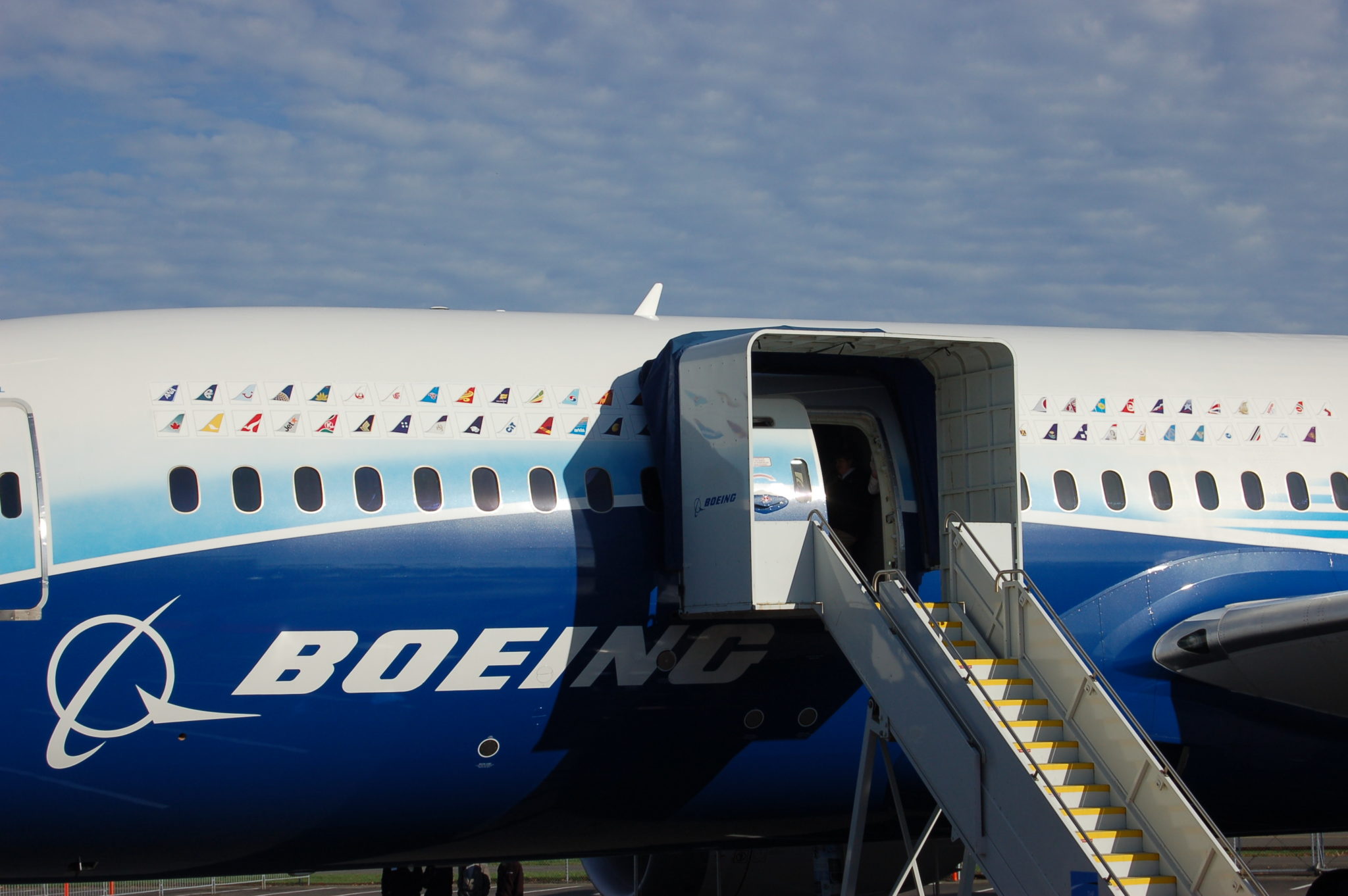
Boeing 787 ZA003, which went on a world sales tour, was donated to Seattle’s Museum of Flight Nov. 8, 2014. The logos of customers bracket the #2 door. Photo by Leeham News and Comment. click to enlage.
To be sure, the donation was made possible by the fact that ZA003 (and 002 and 001) can’t be sold due to the massive rework necessary, and these three airplanes have been written off for more than $2bn. But this doesn’t make the event any less significant.
New and Derivative Airplanes: Some good, some not: Part 2
Part 2 of two parts.
With multiples and multiples of billions of dollars at stake to develop new airplanes, and the billions of dollars of cost overruns at risk, it’s understandable the Airbus and Boeing are shifting to looking at derivatives and incremental improvements now for the lower-risk and ability to “harvest” technology across family lines.
This is hardly new. Airframers have been doing this since the Douglas DC-1 prototype begot the DC-2, which led to the DC-3. The Douglas DC-4 was the basis for the DC-6 and DC-7, for which there were A, B and C versions. Lockheed revamped the L-049 Constellation through several major upgrades (the -649, 749, 1049 and 1649, with several sub-sub-types in between). Convair created the CV-240 and revised it twice with the CV-340 and 440. The Martin 202 became the 303 (dumped after design issues with the 202) and the 404.
The trend continued into the jet age. Douglas created the DC-8-10/20/30/40/50 on the same basic airframe and really went to town with the DC-8 Super 60 Series. The DC-9-10 became the -20/30/40/50, the Super 80 (in four variants) and the basis for the MD-90 and MD-95. Boeing’s ground-breaking 707-120 became the 138/227/320B/C, the 707-020 (more commonly known as the 720), the C-135/KC-135 and a number of other military variants. The fuselage was the basis of the 727, 737 and 757. And so on. (Text continues below the photo.)

Later this month, we will unveil a new, updated Leeham News and Comment with a combination of paid and free content. Watch this space for more information.
European manufacturers of the early jet age followed the same pattern. There were four commercial versions intended for the deHavilland Comet. The Hawker Siddeley came in multiple versions, as did the British Aircraft Corp. BAC-111.
CNAC reunion features surviving WW II pilot, C-47/DC-3
This past weekend we attended a reunion of two of the living pilots, descendents, friends and interested public of the China National Aviation Corp. at the San Francisco International Airport.
We did a detailed write-up for CNN.com. This story and some photos are here.
There was a lot that didn’t fit into the CNN article, for space and for the thrust of the article. In a departure from our usual aviation coverage, we’re sharing the experience below.
Throwback to the 1930s
This weekend we’re heading to San Francisco in style–1930s style. We will be on the Historic Flight Foundation’s Douglas DC-3 from Everett Paine Field to SFO for a reunion of the China National Aviation Corp., CNAC, including a 100-year old veteran of the airline.
We’ll be on HFF’s DC-3, the only surviving CNAC plane, which is today painted in the colors of Pan American World Airways from the era. PAA owned a piece of CNAC before World War II.
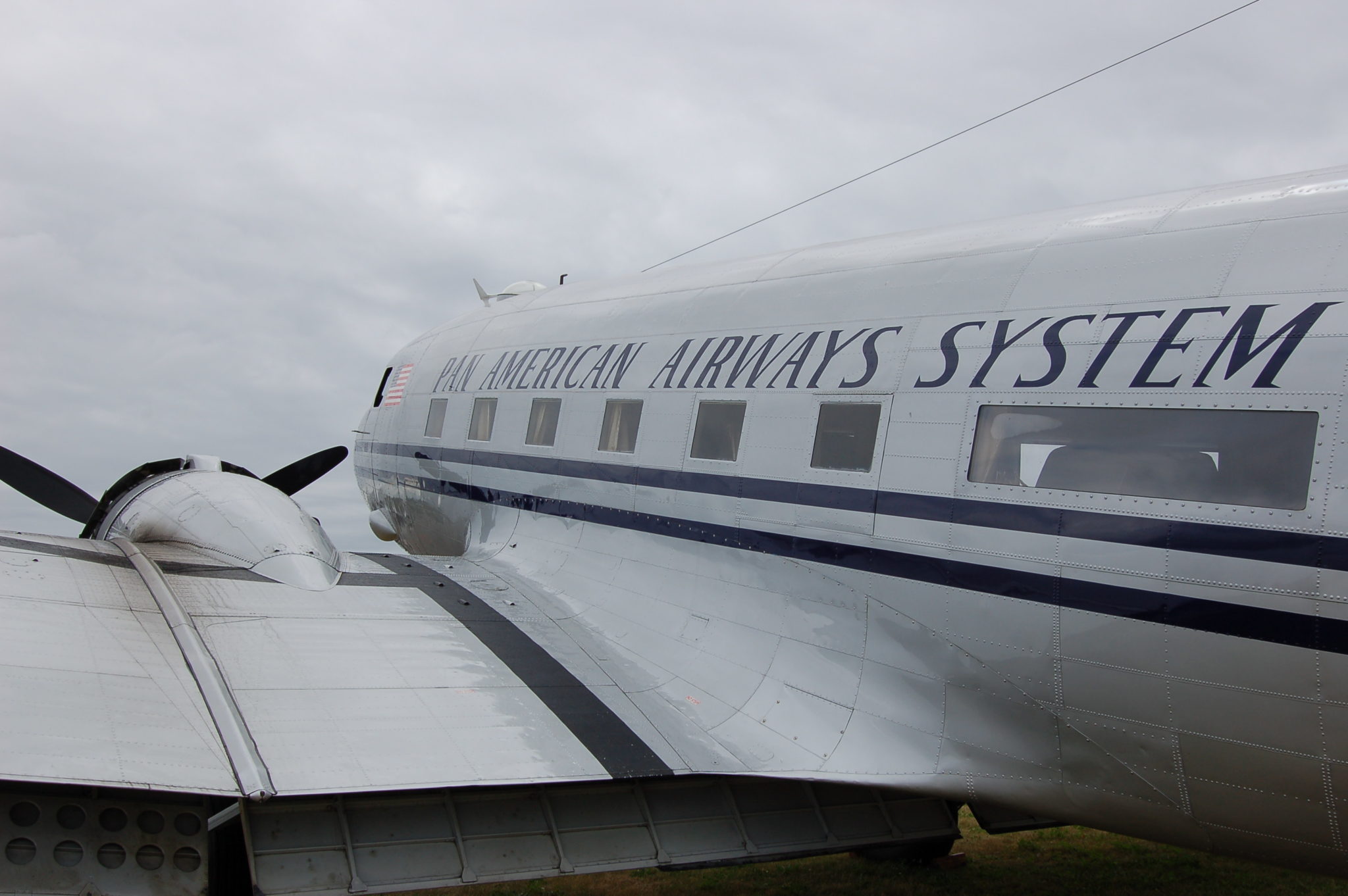
This Douglas DC-3, owned by the Historic Flight Foundation, was operated at one time by China’s CNAC and later as an executive aircraft. It still has the executive interior and panoramic windows of the executive configuration. Photo by Gail Twelves.
The plane eventually became an executive transport and the executive interior is still in it.
The flight will be about four hours each way. This will be the third time we’ve taken a ride on the aircraft, and this will be the longest. Previous rides were an hour long.
Look for our report from the trip on CNN.com, International, Travel next week as well as some additional information here.
An alternative air show
The Farnborough Air Show got all the headlines this month, but we went to a small air show in Everett (WA), right at Paine Field, where Boeing dominates.
The Historic Flight Foundation is the brainchild of John Sessions, who has put together a private collection of all-airworthy airplanes. It’s also near by the Paul Allen (yes, the Microsoft Paul Allen) collection of airworthy airplanes at the Flying Heritage Museum and across the field from the restoration center of the Museum of Flight, which is at Boeing Field.
Bjorn’s Corner: China’s civil aviation, from nothing to world’s largest in 2030
Introduction
By Bjorn Fehrm
14 May 2015, C. Leeham Co: In my ISTAT Asia reports, I wrote about how China will overtake USA as largest civil aviation market in 2030. Airbus China Group chairman, Laurence Barron, and I had a chat after his ISTAT presentation where he described China’s evolution as a civil aviation market and how Airbus gradually worked itself from a late and hesitant start to today’s split of the market with Boeing.
Barron provided his slides, some of which we will use to review how China grew from virtually no civil aviation after the Chinese revolution in 1949 to the world’s largest market by 2030. We will also look at what aircraft have made up this growth and finally describe how Airbus progressed from a latecomer in 1985 to sharing the market with Boeing today.
Read more
19 Comments
Posted on May 14, 2015 by Bjorn Fehrm
Airbus, Airlines, Bjorn's Corner, Boeing, China, Douglas Aircraft Co, Leeham News and Comment, McDonnell Douglas
707, A310, Airbus, Boeing, EADS