
Leeham News and Analysis
There's more to real news than a news release.



Countdown to Boeing’s decision on NMA, Part 2
Subscription Required
Now open to all readers.
Introduction
Jan. 7, 2019, © Leeham News: As the airline, lessor and aerospace industries await Boeing’s decision whether to launch its New Midrange Airplane (NMA, aka 797), as of last month the company still hadn’t closed the business case.
The aerospace analyst from JP Morgan met last month with Boeing’s top executives in Chicago. CEO Dennis Muilenburg and CFO Greg Smith told Seth Seifman that the business case must stand alone, on a program P&L basis, and not rely on aftermarket MRO services through Boeing Global Services. A Boeing spokesman last week reaffirmed the business case is still a work in progress.
As LNC has written many times, the business case involves the usual cost, pricing, production, supply chain and related issues.
But one overarching issue is how bid the market demand is. In large part, this drives everything else.
And market demand continues to be a matter of debate.
Summary
- Boeing says the demand is 4,000-5,000 airplanes over 20 years.
- Nearly everyone else surveyed by LNC sees the demand as closer to 2,300-2,500.
- Engine makers, Tier 1s, LNC, others see the demand as the lower number.
- Dissecting the difference.

Pontifications: Countdown to decision on Boeing’s NMA, Part 1

By Scott Hamilton
Jan. 14, 2019, © Leeham Co.: Two thousand nineteen begins with increasing focus on whether Boeing is going to launch the New Midmarket Aircraft (NMA, aka 797).
Signs all point to a program launch, perhaps at the Paris Air Show. Authority to Offer (ATO) the airplane for sale is expected by March or April.
Engine companies were asked to respond to Requests for Proposals by the end of December. Engine down select is expected soon.
LNC’s Dan Catchpole will be reporting on this process soon.
Airbus holds 56% share of backlogs vs Boeing
Jan. 11, 2019, © Leeham News: Airbus trailed Boeing in net orders in 2018 but it still holds a commanding lead in backlog market share.
With the companies reporting their year-end tallies, Airbus has a 56% share of the backlog to Boeing’s 44%.
Airbus carries the day with narrowbody backlog. Its share is 58% to Boeing’s 42%.
Boeing wins the widebody backlog, 53% to 47%, driven by a broader product line, including strong 777F and KC-46A/767-300ERF backlogs.
When the emerging narrowbody airplane programs of China and Russia, and Embraer’s sole entry into the 100-150 seat sector (based on two-class seating), Boeing’s narrowbody share of the backlog drops from 42% to 40%.
Charts are below. Data is based on firm orders only.
Bjorn’s Corner: Pitch stability, Part 5

By Bjorn Fehrm
Jan. 11, 2019, ©. Leeham News: The week before Christmas we discussed the pitch stability of an airliner. We covered how a horizontal stabilizer made the aircraft stable in pitch, and why transonic airliners used a trimmable horizontal stabilizer rather than trimming with the elevator.
Now we look at some different flight situations with different trim needs before we move into the more troublesome parts of a pitch moment curve.
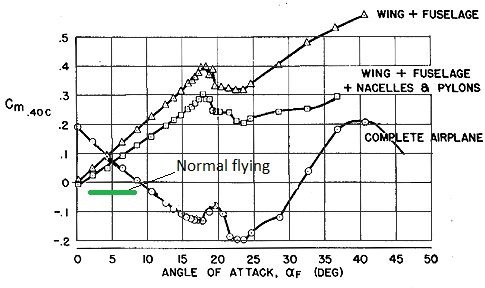
Figure 1. The pitch moment coefficient curve of an early DC-9 candidate. Source: Stanford University.
Brazil OKs Boeing, Embraer JV
Breaking News: Boeing just announced the Brazilian government approved the proposed “strategic partnership” between Boeing and Embraer.
The deal now begins to make the rounds among global governments for anti-trust approvals.
Officials hope the transaction will gain all approvals by the fourth quarter this year.
The press release is below the jump.
Read more
2018 deliveries: Airbus leads Single Aisle, Boeing Widebody and Freighters
By Bjorn Fehrm
Jan. 10, 2019, © Leeham News: Boeing and Airbus came within six aircraft in their 2018 deliveries, 806 versus 800. For orders, Boeing was the leader, with 893 net orders versus Airbus 747.
Looking at Orders and Deliveries for the different segments there are some interesting trends.
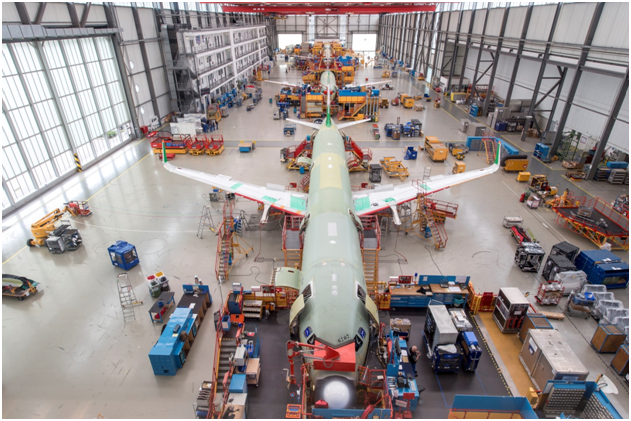
Airbus new Hamburg FAL (Final Assembly Line) for the A320. Source: Airbus.
Boeing and Airbus achieve 800 deliveries for 2018
By Bjorn Fehrm
Jan. 9, 2019, © Leeham News: Boeing delivered 806 aircraft during 2018 while Airbus delivered 800. Both manufacturers missed their 2018 targets, Boeing by 10 aircraft and Airbus by 20 (as the A220 was not included in the original guidance of 800 deliveries for 2018).
Both OEMs struggled with engine deliveries to their best-selling 737 MAX and A320neo. Airbus added A330neo Trent 7000 delivery problems to the mix.

Boeing celebrates the 10,000th 737 delivery to Southwest March 2018. Source: Boeing
Airbus poised to out-deliver Boeing in 2019
Subscription Required
- LNC’s Corporate and Enterprise subscribers received this Jan. 3.
Jan. 8, 2019, © Leeham News: Airbus is positioned to out-deliver Boeing this year, boosted by the addition of the Bombardier CSeries acquisition last year.
LNC projects that Airbus will deliver nearly 950 airliners this compared, compared with Boeing’s projected deliveries of about 890 jets.
These are LNC forecasts, not those of the manufacturers. Guidance for the year should come on their respective year-end earnings calls: February for Airbus and Jan. 30 for Boeing.
2019 Outlook: A critical year for Mitsubishi’s MRJ regional jet
By Bjorn Fehrm
Subscription Required
Introduction
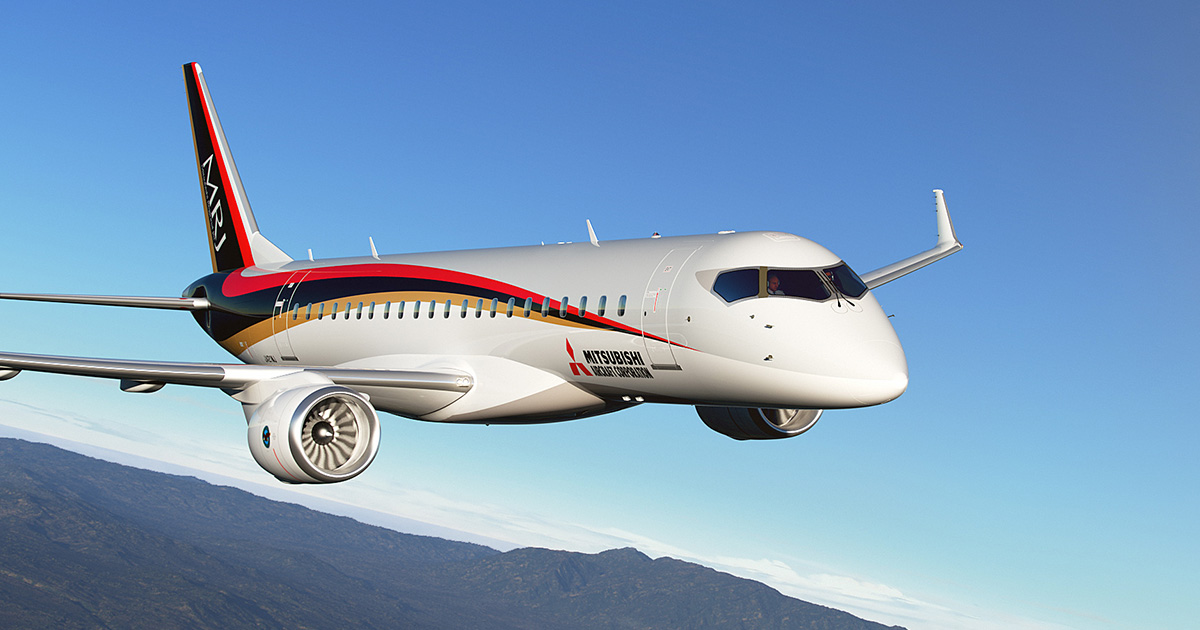
January 8, 2019, © Leeham News.: Mitsubishi Aircraft’s MRJ should originally have entered service 2013. Now the plan is 2020, a record seven years of delay. But 2020 can be the last delay. On December 21, the program got “Type Inspection Authorization” from its Certification office, the JCAB (Japan’s Civil Aviation Bureau).
The brunt of Certification flying should be finished in 2019. Then follows the paperwork and the preparation for service entry with ANA. The year will be critical for how the MRJ project will enter service and ramp serial production.
Summary:
- The MRJ has seen more delayed years than its original schedule. But the last declared delay might be the final one.
- The project got a declaration of health just before Christmas. Its oversight authority, JDAC, supported by the FAA, said it was ready to start Certification flights with the aircraft.
- It’s now for Mitsubishi to succeed with these flight so ANA can get the first aircraft by 2020.
- Work on capacity improvements for the smaller variant, the MRJ70, is also ongoing to make it more suitable for the US Scope Clause market.
Pontifications: AFA holds aerospace job fair that WA state should have done
By Scott Hamilton
Jan. 7, 2019, © Leeham News: The first dedicated aerospace job fair in Washington State may draw more than 1,500 people today, says the president of the organizer, Aerospace Futures Alliance.
Kelly Maloney, AFA president, opened the fair day-long today citing 1,100 pre-opening registrations by job seekers. She told me later that another 500 walk-ins may show up.
Thirty-eight companies, ranging from the Seattle area’s giant, Boeing, to Tier 3 and Tier 4 suppliers, were present to receive the hopefuls, who ranged from new entrants into the job market to upper-middle aged people.