
Leeham News and Analysis
There's more to real news than a news release.



Aging Boeing 757 engines skew operating expenses
Jan. 8, 2015: Engines on the aging fleet of Boeing 757s are a key reason operating costs of this rather unique airplane are between 20% and 30% more than a Boeing 737-9 or an Airbus A321neo.
“The thing to worry about most for the 757 engines is the cost to overhaul,” says an industry official who trades in 757s. “The cost of producing life limited parts is crippling the marketplace.”
Total costs and the direct operating costs are being directly affect by the engine costs, the person says, who doesn’t want to be identified because of the sensitivity of the topic.
2015 a year of execution for Embraer commercial
Subscription Required
Introduction
Jan. 7, 2015: Embraer, the world’s #3 commercial airplane manufacturer,  enters 2015 viewing this as a year of execution, says its chief commercial officer, John S. Slattery.
There are three pillars:
- Continuing to fill out the balance of the current generation orders and commitments in advance of the E-Jet E2 re-engined airplane scheduled for entry-into-service in 2018;
- Execution to continue to grow the commitments for the E2—there are already 590; and
- Execution for the next several years for the milestones of the E2 development.
Summary
- Customer base goal by the end of 2017;
- Customer support;
- Barriers to entry for competitors.
Odds and Ends: 737 MAX order breakdown; Airbus to top Boeing; Embraer to PNAA event
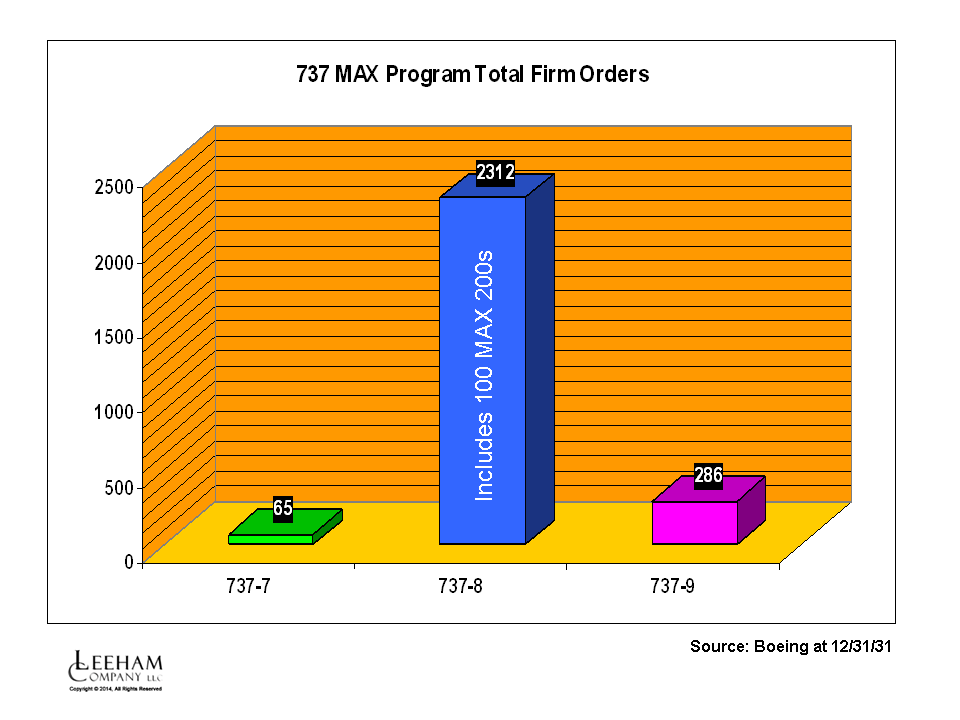
Click on image to enlarge into a crisp view. Source: Boeing.
Jan. 6, 2015: 737 MAX Orders: Boeing has broken down the 737 MAX orders for the entire program in response to our inquiry. The 737-8 has captured 87% of the program orders since launch in 2011. The MAX 8 includes the 100 MAX 200 orders for the high density version, placed by Ryanair last year. The MAX 9 has 11% and the MAX 7 just 2% (figures are rounded).
Airbus to top Boeing: It’s not really a surprise, because it seems to happen just about every year. Reuters is reporting that Airbus will top Boeing in gross and net orders when it reports its 2014 performance next week.
Embraer to PNAA: Embraer’s chief commercial officer, John Slattery, will speak at the Feb. 10-12 conference for the Pacific Northwest Aerospace Alliance. EMB has presented previously but this is the first time Slattery is joining the conference. Click on the banner ad above to go directly to the conference website.
Boeing 2014 orders: 1,550 gross, 1,432 net
Update, 8:45am PST: Boeing sent us this breakout of 777 and 737 orders:
777-300ER: 49
777 Freighter: 14
777X: 220
737 MAX: 891
Original Post:
Boeing received 1,550 gross orders and 1,432 net orders in 2014, one of its best years.
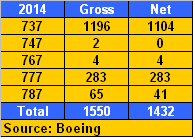 As is typical, the narrow-body 737 was by far and away the leader in orders. Boeing doesn’t break out the 737NG v 737 MAX in its monthly table. The 777 was buoyed by firming up the massive number of 777X commitments announced at the Dubai Air Show in November 2013. Although Boeing doesn’t break out, in this table, the 777X v 777 Classic, the company ended the year with around 60 777 Classic orders, an important number to fill the production gap we and others have been writing about last year.
The 767 commercial model continues to wind down, as the last ones off the line–all freighters–get delivered. The line will shift over to solely the USAF KC-46A once the 767Fs are delivered.
The 747-8 put in another dismal year, with two gross orders and two cancellations.
Boeing delivered 723 airplanes last year: 485 737s, 19 747s, 6 767s, 99 777s, 114 787s.
Reuters has this update of Airbus’ order position through November, in advance of the annual Airbus press conference on Jan. 13, where full year numbers will be announced. Airbus has a habit of finishing Decembers with a surge of orders, often topping the Boeing numbers.
Real time tracking, FDR transmission needs to happen now
As time passes following the Dec. 28 crash of AirAsia flight 8501, it has become even more apparent that the need for real time tracking of the position of a commercial flight and real time transmission of flight data recorder information is necessary.
The issues aren’t new. Airplanes have gone missing since the dawn of aviation. Real impetus began to pick up after the 2009 disappearance of Air France flight 447. This flight went down over the South Atlantic in proximity to major thunderstorms. Radar coverage indicated the flight track but not the final position. ACARS, the system monitoring the health of the aircraft’s systems, transmitted enough information so that the airline, investigators and Airbus had a reasonable picture of what happened but a picture that was incomplete. It took five days to locate the first debris and bodies in the water and two years to locate and retrieve the black boxes, which filled in the picture of a flight crew in complete befuddlement over what was happening to their airplane. The accident was entirely avoidable, and the circumstances incorporated into future training may well save lives.
Despite the delay in finding the airplane and black boxes, the airline industry and regulators did nothing to require real time tracking and data transmission.
Odds and Ends: AirAsia 8501, PNAA Conference, FWIW
Jan. 2, 2014: AirAsia 8501: Our friend Geoff Thomas has an interesting commentary about the AirAsia 8501 story. Also, an Airbus A330 pilot for a major US airline, offered these observations about QZ8501. A Linkedin profile suggests this pilot flies for Delta Air Lines.
We are now beginning to see more and more “conclusions” about what happened to 8501 from people who are being described as “experts.” Some of these are people we’ve never heard of, although this isn’t necessarily indicative that they don’t know what they are talking about–but we don’t think they do.
Since the airplane hasn’t been confirmed as found (searchers only think they’ve found it, but bad weather and bad seas have, at this writing, prevented confirmation), nor have the black boxes been recovered, the conclusions being set forth are interesting theories but that’s all they are.
Most of these possibilities are precisely what we’ve reported as areas of investigation and questions to be asked and answered. They way these “experts” are positioning possibilities is actually pretty embarrassing.
Treat these reports with the skepticism they deserve.
One thing we are surprised at: how quickly one of the few victims recovered has been buried. We thought an autopsy would take longer, and an autopsy would be the first clear indication of what happened: whether the victims died by blunt force trauma (i.e, impact with the water) or from decompression (suggesting an inflight fuselage rupture or mid-air break up).
Sixteen bodies are now reported to have been recovered (at 8:30pm PST Jan. 1).
AirAsia update, Dec. 30: Key questions in the investigation
Dec. 30, 2014: With the apparent discovery of the main wreckage of AirAsia Flt 8501 in about 100 ft of water, recovery of the airplane and its black boxes should be a relatively straight-forward operation.
Our previous posts have outlined general areas of inquiry. With this post, we drill down into some of the flight and airplane questions that will be part of the inquiry. We talked with an Airbus A320 captain for a major US airline in forming these issues. This captain has been flying for US carriers for 30 years and is rated on Boeing 737s, the McDonnell Douglas DC-10 and the A320.
Key points:
AirAsia update: debris from flight confirmed; airline was implementing real-time tracking
Dec. 30, 2014: Debris and bodies have been found and confirmed coming from AirAsia Flight QZ8501, bringing closure for the families and friends of the flight that disappeared on Sunday local time.
Reports of shadows that could be a wing or fuselage in water about 30 meters deep have also been seen.
Some debris and bodies have already been recovered.
If the main body of the wreckage has also been spotted, recovery of the all-important flight data and cockpit voice recorders could come rather quickly.