
Leeham News and Analysis
There's more to real news than a news release.


Odds and Ends: A350 batteries; A350 V 1.0; Southwest schedule
A350 batteries: Flight Global has a detailed story about the Airbus approach to lithium-ion batteries in the A350. The approach is more conservative than Boeing’s for the 787.
A350 Version 1.0: A blog called A350 XWB News has a retrospective on the A350’s original proposal (which we call Version 1.0, because the design went through so many iterations). It’s got the original brochure reproduced. It’s an interesting recollection, and one to compare with the A330neo. Boeing dismisses the A330neo as A350 V 1.0, but it’s really not when you compare.
A350 Final version: A350 XWB production is tracking to plan, first A350 after Qatar’s initial 8 (MSN6 to 13), MSN14 to Vietnam Airlines is going to ground tests (Station 30) after getting wings and empennage in Station 40 at the Airbus Final Assembly Line (FAL) in Tolouse. We are following this program carefully since start and the roll out of the latest XWB from wing join was within days of our prediction 6 months ago, thereby the A350 ramp to three FAL starts by end of year is tracking so far.
A380 downed by mops: Aviation Week has the story on how Qantas cleaners got the water flowing in their A380s when it should not. The incident is old (80 gallons of water flowing around in the fittings of the A380 when climbing out of LAX to Melbourne, first time in June) but one has now found the cause; the cleaners mops were getting the water couplings in a galley unlatched. Small things having big impact.
Boeing record: Qatar airways took delivery of three 787 and one 777 in one day this week; here the Flightglobal version of the Boeing announcement. Airline CEO Al Baker says ““Never in the history of an airline have so many aircraft been taken in just one day.”
Southwest schedule: Southwest Airlines adjusted its schedule two months ago to improve its on-time performance, and revealed that the new times are working.
Southwest, once boasting of being #1, 2 or 3 in on-time ratings among US major carriers, saw a steady decline in recent years as it ramped up service in congested airports, expanded in regions that were more prone to weather delays, added larger airplanes (the Boeing 737-800) to its schedule. After acquiring AirTran, Southwest tightened the schedule in an effort to cut turn-times. But AirTran’s traditional hub operation vs WN’s largely point-to-point didn’t lend itself to the tighter turns Southwest scheduled. It didn’t take a lot of insight to understand why delays were showing up on the AirTran fleet. Southwest’s OT performance is still not where it once was–it’s currently at 78.9% when it used to run in the 80s–but it’s better.
Delta’s wide-body fleet plan: could it include used 777-200ERs?
Delta Air Lines is supposed to make a decision on its Request for Proposals for 50 wide-body aircraft before the end of this year, perhaps as early as next month. The competition is hot between the Airbus A330-900, the A350-900 and the Boeing 787-9.
Delta is understood to use the aircraft to beef up its growing Seattle hub across the Pacific; for its Detroit hub, also to Asia; and its New York JFK trans-Atlantic hub.
In addition, Delta is phasing out the last 14 of its Boeing 747-400s inherited from its merger with Northwest Airlines by the end of next year.
The A330-900 is viewed as a trans-Atlantic airplane, while the others are viewed as largely, but not necessarily solely, trans-Pacific aircraft, according to our information.
But there could be another wrinkle. On Delta’s third quarter earnings call, CEO Richard Anderson made some intriguing comments that could raise another possibility: acquisition of used Boeing 777-200ERs.
To put this in context, recall that Anderson and Delta actively seek out inexpensive used aircraft which, while hardly competitive at high fuel prices when comparing operating costs vs new aircraft, provide low capital acquisition costs and low ownership costs.
Here’s the exchange on the earnings call, as recorded by Seeking Alpha’s transcript:
Odds and Ends: MTU on A380; lessons learned; Alaska Air v Delta; GOL looking for airplanes; Boeing downgrade and upgrade
MTU on A380: The German company MTU, which is a key supplier on a variety of Airbus and Boeing engines, questions the potential market for an A380neo, according to this article from Reuters. Our Market Intelligence indicates Airbus is moving toward a re-engined airplane, although an Airbus official denied this to us this week. Reuters’ sources suggest work is ramping up.
Tapping lessons learned: The Puget Sound Business Journal has a somewhat different approach to the story earlier this week on the groundbreaking for the Boeing 777X wing factory. Steve Wilhelm focuses on Boeing’s tapping of lessons learned on the 737 and 787 programs.
Alaska Air v Delta Air: Months and months ago (almost a year), we were the first to write that hand-wringing over Delta Air Lines’ growth at Seattle, viewed as a major run at Alaska Airlines, was over-wrought. The growth was to support Delta’s growing international hub and while the growth came on many Alaska routes, Alaska’s dominance would prevail. A few months later, we pointed out that Delta’s growth was coming at the expense of Southwest and United airlines; Alaska was solidifying its position. (It also posted record 3Q earnings this week.)
The Puget Sound Business Journal has this story about how the three generations of the Boeing 737 is helping Alaska face off Delta.
GOL looking for planes: Brazil’s GOL is looking at the Boeing 737-7 and the Embraer E-195 E2 to renew its 737NG fleet, according to this Bloomberg report. Next week we’ll be taking another in our series of looks at EMB’s approach to the market with a discussion of the CASM Paradigm.
Boeing downgrade and upgrade: Credit Suisse yesterday downgraded Boeing from Outperform to Neutral (Buy to Hold) on the basis of 787 deferred costs and lower free cash flow. Wells Fargo reiterated its Hold rating. Zacks went from Neutral to Buy. Stern Agee reiterated its Buy.
Part 2: Boeing 757: Airbus A321neoLR as a replacement on long and thin routes
Subscription required.
By Bjorn Fehrm
Part 2 of 3
Introduction
In Part 2 of our three-part 757 Replacement analysis, we take a close look at Airbus’ new 97 tonnes take off weight A321neo, revealed by Leeham News and Comment October 21. We call the 97t airplane the A321neoLR (Long Range); Airbus has yet to name the aircraft, which it began showing to airlines last week.
 We analyze the A321neoLR’s capabilities and limitations when compared to the aircraft it intends to replace, the Boeing 757-200W. We have chosen to do so using a real airline configuration as opposed to an OEM’s typical seating layout. By comparing the 757-200W and the A321neoLR over the route structure that United Airlines is using the 757 today, we can better see the characteristics of the A321neoLR and what operational consequences the differences between the types would mean for the airlines. Before we start, a short recap of Part 1 about the 757 and its replacement candidates. Here is what we found:
- the seating capacity of the A321 is within 10 seats of the 757-200 in a standard configuration; the 737 MAX9 is trailing with about 20 fewer seats.
- the myth about the strong engines of the 757 is just that, a myth.
- the good field performance of the 757 is coming from its wing more than any advantage on the engine side
- the A321neo and 737 MAX9 were hindered in their capability to replace the 757 for long and thin international routes by characteristics that can be changed. For the A321neo, this may be accomplished with rather modest changes to Max Take Off Weight (MTOW) and tankage. For the 737 MAX9, more elaborate changes to the wing and engines are required, both hard to do.
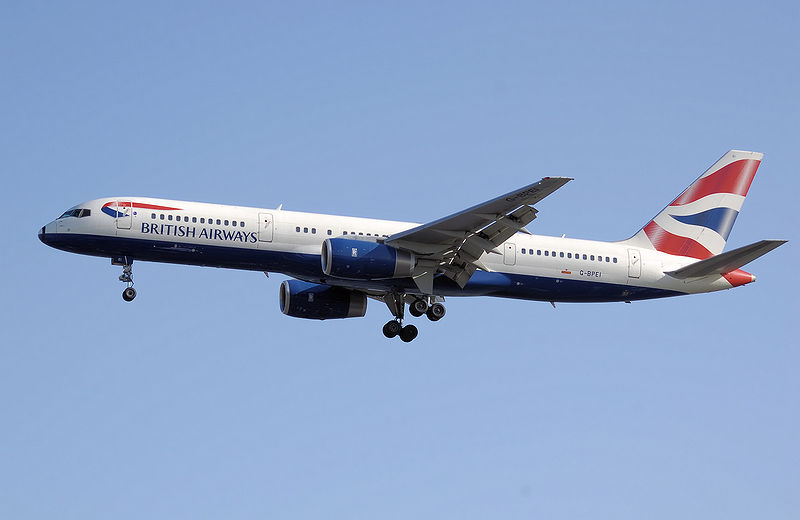
Figure 1. Boeing 757-200 of British Airways which launched the 757 together with Eastern Airlines 1983. Source: Wikimedia.
Summary, Part 2
- We will now look in detail on the changes Airbus is doing on the A321neoLR, what each change brings and any restrictions that remain.
- We will also detail why we think it will be harder for Boeing to match the A321neoLR with a 737 MAX9 development.
- We detail prime, present 757W long-thin routes.
- We present 757W international, A321neoLR and 737 MAX9 “long range” configurations.
- We provide economic comparisons such as Payload-Range charts and Fuel consumption per trip and per seat diagrams.
In the final Part 3, will look at Boeing’s alternative to an A321neoLR, a clean sheet New Single Aisle (NSA) and a prospective Small Twin Aisle (STA) design and how much such an approach would surpass the A321neoLR on medium and long haul networks and when it could be available.
Air Berlin 787 cancellation potentially gives Boeing big advantage in Delta order competition
The announcement last week that AirBerlin canceled orders for 15 Boeing 787s gives Boeing an unexpected, big advantage in the contest for a big wide-body order from Delta Air Lines–depending on when Delta wants the airplanes.
The competition apparently has been narrowed to the Airbus A350-900 and the Boeing 787-9, according to Flight Global. Based on this article, the Airbus A330-900 neo has been eliminated, which if true is a blow to the fledgling program in which Airbus had counted on Delta to be a launch customer.
Outside of the OEMs and Delta, it’s not known when Delta wants 50 widebodies. But the A350 and 787 are essentially sold out through the end of the decade, though both OEMs can typically find delivery slots for important campaigns such as this one by over-booking or persuading other customers to move their delivery positions.
Airbus has plenty of slots for the A330neo from 4Q2017, when entry-into-service is planned. But with the apparent elimination of the A330neo from the competition, delivery schedule becomes important–and the AirBerlin cancellation works to Boeing’s advantage.
Etihad, Emirates refute charges of favoritism from government owners
Two of the Middle East’s most aggressively growing airlines said charges that they benefit from government subsidies, artificially low fuel prices, cheap airport facilities and preferential financing refuted these charges at the World Routes conference in Chicago this week.
Neither, however, addressed charges they unfairly benefit from US ExIm Bank funding, a particularly sensitive topic for Delta Air Lines which has been waging an effective campaign to cast doubt over the Depression-era institution intended to support US exports. Boeing is the largest user of ExIm financing and Emirates in particular has been an active participant in the program. Delta claims ExIm provides below-market rate fees and interest charges.
Part 3: Boeing 757 replacement: 757 and Airbus A321neoLR versus clean sheet designs.
Subscription required.
By Bjorn Fehrm
Part 3 of 3
Introduction
In Part 2 of our three-part 757 Replacement analysis, we took a close look at Airbus’ new 97 tonne take-off weight A321neo, revealed in a world exclusive by Leeham News and Comment October 21. We analyzed the A321neoLR’s capabilities and limitations when compared to Boeing 757-200W and we saw that it could do the international flights that the 757-200 does with about 25% better efficiency. In this final Part 3, we will now compare the 757 and A321neoLR against what can be Boeing’s reaction, a clean sheet New Single Aisle, NSA, or New Light Twin Aisle, (NLT). First the conclusions from Part 2:
Summary
For Part 3 we can summarize:
Figure 1. Fuselage cross sections of our models of NSA and NLT. Source: Leeham Co.
Read more
5 Comments
Posted on October 28, 2014 by Bjorn Fehrm
Airbus, Airlines, Boeing, CFM, China, Comac, CSeries, Embraer, GE Aviation, Irkut, Leeham Co., Leeham News and Comment, Pratt & Whitney, Premium, Rolls-Royce, Uncategorized
737, 737 MAX, A320, A320NEO, Airbus, Boeing, Bombardier, CFM, Comac, CSeries, Embraer, GTF, Pratt & Whitney, Rolls-Royce